
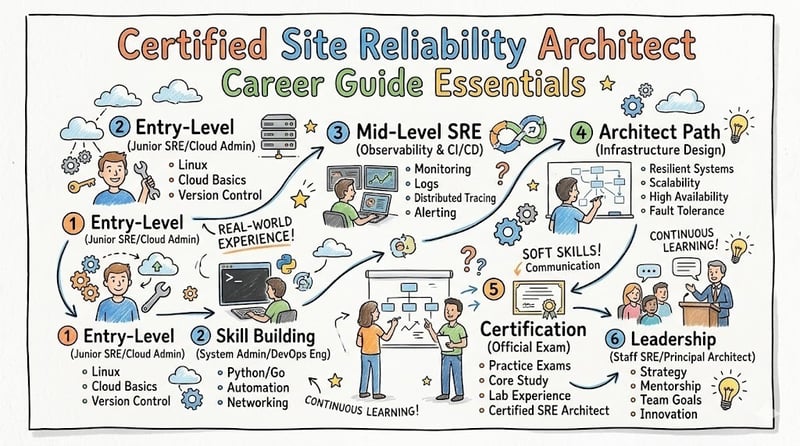
Building resilient, scalable, and highly available distributed systems requires specialized expertise that combines software engineering with enterprise infrastructure management. This comprehensive career roadmap simplifies your journey toward mastering production environments. It provides technical professionals with a clear framework to evaluate the Certified Site Reliability Architect program, understand its real-world engineering impact, and choose the most effective learning paths for their specific career goals. By reviewing this structured analysis, software engineers and technology leaders can make informed decisions regarding skill acquisition, resource allocation, and professional advancement within the modern cloud ecosystem hosted by SreSchool.
What is the Certified Site Reliability Architect?
The Certified Site Reliability Architect designation represents a rigorous professional milestone focused on the design, implementation, and optimization of highly available distributed systems. It validates an engineer's ability to minimize system downtime, manage infrastructure at scale, and implement automation that eliminates repetitive operational toil.
Rather than focusing purely on conceptual definitions, this architecture program prioritizes production-grade engineering principles. It aligns directly with the practical needs of modern enterprises by teaching professionals how to handle real-world service degradation, orchestrate containerized microservices, and manage large-scale cloud infrastructure safely.
Who Should Pursue Certified Site Reliability Architect?
This architectural framework specifically benefits systems engineers, software developers, cloud architects, and platform engineering professionals who manage production workloads. It bridges the gap between traditional software development and operations, making it highly valuable for specialists aiming to improve system reliability.
Beginners gain a structured foundation in production discipline, while seasoned engineers and managers learn to design robust architectures that protect organizational revenue. The curriculum carries significant global and regional weight, particularly within major technology hubs across India, North America, and Europe, where large enterprises actively recruit professionals capable of managing massive user traffic without service interruption.
Why Certified Site Reliability Architect is Valuable Today and Beyond
As enterprises continue to migrate complex workloads to multi-cloud environments, the demand for architecture professionals who can guarantee system uptime remains exceptionally high. Tools and specific cloud platforms will inevitably change over time, but the underlying core principles of reliability, observability, and automation do not change.
Investing time into this professional program provides long-term career security by focusing on foundational architectural patterns instead of temporary software trends. This strategic approach ensures a high return on investment, as companies consistently prioritize hiring engineers who can prevent expensive outages and optimize resource utilization.
Certified Site Reliability Architect Certification Overview
The structured educational program is delivered through specialized training options and evaluated by a comprehensive assessment process. It establishes a uniform standard for evaluating technical competency across various engineering domains.
The evaluation process measures actual engineering capability through practical problem-solving scenarios rather than basic multiple-choice memorization. This methodology ensures that certified professionals possess the actual technical competence required to debug real production infrastructure, design fault-tolerant systems, and lead complex incident response efforts effectively.
Certified Site Reliability Architect Certification Tracks & Levels
The curriculum features structured progression paths divided into foundation, professional, and expert tiers to match different career stages. These levels allow engineering professionals to master fundamental concepts before moving on to complex distributed systems design.
Specialized paths allow professionals to align their studies with specific industry roles, such as automated operations, infrastructure security, or cloud financial management. This step-by-step structure supports logical career growth, helping engineers move systematically from executing basic technical tasks to designing entire enterprise architectures.
Complete Certified Site Reliability Architect Certification Table
| Track | Level | Who it’s for | Prerequisites | Skills Covered | Recommended Order |
|---|---|---|---|---|---|
| Operations Track | Foundation | Systems Administrators | Basic Linux CLI | Observability, Linux commands | First |
| Systems Track | Professional | Core DevOps Engineers | Cloud basics, scripting | Infrastructure as Code, CI/CD | Second |
| Reliability Track | Professional | Site Reliability Specialists | Container concepts | Kubernetes, Service Mesh | Third |
| Architecture Track | Advanced | Principal Architects | Advanced Networking | Distributed Systems, Disaster Recovery | Fourth |
Detailed Guide for Each Certified Site Reliability Architect Certification
Certified Site Reliability Architect – Foundation Level
What it is
This foundation level validates a professional's understanding of basic reliability concepts, foundational monitoring setups, and essential command-line troubleshooting tools.
Who should take it
Systems administrators, junior developers, and technical support engineers seeking a transition into reliability engineering should take this exam.
Skills you’ll gain
- Configuring fundamental metric collection tools
- Analyzing basic application and system log files
- Utilizing command-line utilities for network debugging
Real-world projects you should be able to do
- Deploy a basic central logging agent on a cloud virtual machine instance
- Build a baseline infrastructure monitoring dashboard with automated alerts
Preparation plan
- 7-14 Days: Focus heavily on understanding fundamental service level indicators and core metrics terminology.
- 30 Days: Build simple monitoring configurations inside a local laboratory environment using virtualized infrastructure.
- 60 Days: Review sample troubleshooting scenarios and practice debugging basic operating system resource constraints.
Common mistakes
- Spending too much time memorizing definitions instead of practicing basic shell commands
- Neglecting the core mathematical logic behind calculation of system availability targets
Best next certification after this
- Same-track option: Professional Level Reliability Specialist
- Cross-track option: Cloud Infrastructure Operations Expert
- Leadership option: Technical Team Lead Foundation
Certified Site Reliability Architect – Professional Level
What it is
This professional level validates expertise in designing automated delivery pipelines, managing containerized applications, and implementing deep infrastructure observability frameworks.
Who should take it
Mid-level DevOps engineers, systems engineers, and platform developers who manage container workloads in production environments.
Skills you’ll gain
- Orchestrating microservices using production-grade clusters
- Writing modular infrastructure as code declarations
- Implementing comprehensive distributed tracing across multiple services
Real-world projects you should be able to do
- Build a zero-downtime deployment pipeline using progressive delivery strategies
- Create an automated autoscaling policy based on custom application traffic metrics
Preparation plan
- 7-14 Days: Review advanced container networking models and persistent storage allocation strategies.
- 30 Days: Write reusable infrastructure declarations to deploy multi-tier web applications automatically.
- 60 Days: Execute simulated failure injections inside a test cluster to evaluate monitoring responses.
Common mistakes
- Relying entirely on manual cloud console actions instead of utilizing infrastructure code
- Ignoring the security policies required when configuration data moves through automated pipelines
Best next certification after this
- Same-track option: Advanced Site Reliability Architect
- Cross-track option: Enterprise Security Infrastructure Specialist
- Leadership option: Systems Engineering Manager Track
Certified Site Reliability Architect – Advanced Level
What it is
This advanced level validates an engineer's capability to architect large-scale distributed systems, design complex disaster recovery topologies, and lead cross-organizational post-mortem investigations.
Who should take it
Principal engineers, senior infrastructure architects, and technical directors responsible for the overall availability of enterprise platforms.
Skills you’ll gain
- Designing multi-region active-active database and application deployments
- Implementing chaos engineering principles inside production ecosystems
- Formulating cross-organization technical governance and reliability metrics
Real-world projects you should be able to do
- Architect a regional failover mechanism that achieves a low recovery time objective
- Design a comprehensive chaos engineering experiment that safely validates platform resilience
Preparation plan
- 7-14 Days: Study complex distributed consensus protocols and global traffic routing algorithms deeply.
- 30 Days: Analyze historical major platform outages and map out architectural remediations for each case.
- 60 Days: Construct and document a comprehensive disaster recovery simulation across independent cloud zones.
Common mistakes
- Designing overly complex architectures that increase operational overhead unnecessarily
- Failing to align technical reliability metrics with actual business performance outcomes
Best next certification after this
- Same-track option: Enterprise Cloud Fellow Architecture
- Cross-track option: Corporate Financial Infrastructure Planner
- Leadership option: Chief Technology Officer Strategic Directive
Choose Your Learning Path
DevOps Path
This path concentrates on building fast, secure, and reliable software delivery pipelines. Professionals master automated testing integration, artifact management, and continuous deployment workflows. The path emphasizes shortening the feedback loop between development and operations while keeping software quality high.
DevSecOps Path
This curriculum embeds automated security controls directly into the modern engineering lifecycle. Engineers learn to implement static and dynamic application security testing inside delivery pipelines without reducing deployment velocity. The focus centers on shifting security mechanisms leftward to catch code vulnerabilities early.
SRE Path
This roadmap centers on maintaining operational health, system availability, and platform performance. Engineers focus on error budget policies, deep observability, incident management procedures, and the elimination of operational toil through software automation. It trains professionals to manage scale efficiently.
AIOps Path
This path teaches engineers to apply machine learning models to enterprise operational data. Professionals learn to analyze massive volumes of log messages, track system metrics, and process telemetry alerts automatically to detect anomalies before outages occur. It focuses on predictive infrastructure maintenance.
MLOps Path
This specialty addresses the specific architectural patterns needed to deploy machine learning models to production reliably. Engineers learn to manage automated data engineering pipelines, handle version control for complex models, and monitor model performance drift over time. It bridges data science and systems engineering.
DataOps Path
This track optimizes the delivery, quality, and reliability of large-scale data analytics pipelines. Professionals learn to apply continuous integration principles to data structures, monitor database migration reliability, and automate complex data transformations. It ensures data consumers receive accurate information.
FinOps Path
This discipline combines cloud financial accountability with cloud infrastructure engineering. Professionals master cloud cost allocation methodologies, automated resource optimization techniques, and budget anomaly detection strategies. It allows engineering teams to maximize the business value of every dollar spent on cloud resources.
Role → Recommended Certified Site Reliability Architect Certifications
| Role | Recommended Certifications |
|---|---|
| DevOps Engineer | Professional Level Reliability Specialist, Systems Track Professional |
| SRE | Professional Level Reliability Specialist, Advanced Site Reliability Architect |
| Platform Engineer | Systems Track Professional, Advanced Site Reliability Architect |
| Cloud Engineer | Operations Track Foundation, Systems Track Professional |
| Security Engineer | Enterprise Security Infrastructure Specialist, Operations Track Foundation |
| Data Engineer | Data Infrastructure Specialist, Operations Track Foundation |
| FinOps Practitioner | Corporate Financial Infrastructure Planner, Operations Track Foundation |
| Engineering Manager | Systems Engineering Manager Track, Operations Track Foundation |
Next Certifications to Take After Certified Site Reliability Architect
Same Track Progression
Professionals looking to deepen their technical specialization should focus on mastering advanced infrastructure automation, complex systems debugging, and deep performance tuning. This involves studying specialized kernel diagnostics, container runtime security, and large-scale service mesh configurations. Pursuing these deep topics ensures you can handle the most complex reliability challenges an enterprise might encounter.
Cross-Track Expansion
Broadening your technical skill set involves exploring domains that directly touch production platforms, such as cloud financial analysis or advanced data infrastructure management. Learning how data pipelines operate or how cloud costs impact corporate profitability makes you a more versatile asset. This expansion allows architects to communicate effectively across diverse business units and engineering teams.
Leadership & Management Track
Transitioning toward leadership positions requires shifting focus from writing code to guiding engineering teams and aligning technical choices with business strategies. Professionals should study team dynamics, incident communication management, and technical risk assessment frameworks. This preparation supports a logical move into roles like engineering manager, director of platform stability, or infrastructure architect lead.
Training & Certification Support Providers for Certified Site Reliability Architect
DevOpsSchool offers comprehensive training programs tailored to modern software delivery paradigms. The organization focuses on providing extensive practical laboratories where engineers work with live environments. Their courses cover everything from basic continuous integration setups to complex configuration management strategies for global enterprises.
Cotocus provides specialized enterprise consultation and technical training solutions. The instructor team emphasizes real-world application, helping corporate teams adopt advanced container orchestration platforms smoothly. Their curriculum directly mirrors the challenges faced by engineering teams during large-scale modern cloud migrations.
Scmgalaxy functions as a deep knowledge community and educational resource center for configuration management professionals. The platform offers step-by-step tutorials, technical articles, and structured workshops focused on building stable delivery workflows. It helps engineers master the nuances of version control architecture.
BestDevOps delivers targeted training experiences designed to prepare technical professionals for rigorous industry examinations. Their educational methodology isolates complex architectural concepts and breaks them down into accessible learning units. The courses maintain a strong focus on production-grade infrastructure stability patterns.
devsecopsschool.com provides focused educational paths that center entirely on integrating security frameworks into automated development cycles. Students learn to implement vulnerability scanning, compliance monitoring, and secrets management tools safely within code pipelines. The curriculum helps organizations maintain security without sacrificing engineering speed.
sreschool.com focuses exclusively on platform reliability, systems engineering discipline, and advanced cloud architecture training. The programs are designed by active industry practitioners who teach students how to manage production incidents, configure deep observability, and eliminate operational toil. The coursework emphasizes hands-on laboratory exercises.
aiopsschool.com delivers cutting-edge instruction on applying artificial intelligence patterns to modern IT operations. The coursework guides engineers through building automated anomaly detection systems and processing telemetry data using machine learning algorithms. This training helps teams move toward predictive infrastructure management models.
dataopsschool.com addresses the specific educational needs of professionals managing large enterprise data architecture delivery tracks. The training covers data pipeline automation, data quality monitoring, and version control for large databases. It helps data engineers maintain high pipeline uptime and accurate reporting systems.
finopsschool.com bridges the gap between engineering allocation choices and corporate financial management goals. The curriculum teaches technology professionals how to track cloud spend, analyze usage metrics, and implement automated cost-saving policies safely. This specialized training helps organizations optimize their overall cloud investments.
Frequently Asked Questions
- How long does it typically take to prepare for the foundational examination?
Most technical professionals with basic systems experience require approximately four to six weeks of consistent study to pass the initial exam.
- Do these architectural credentials expire over time?
Yes, the credentials remain valid for a period of two years, after which professionals complete a recertification update to demonstrate current industry knowledge.
- Is previous software coding experience absolutely required?
Basic scripting familiarity in languages like Python or Go is highly recommended, as automation forms a core pillar of reliability architecture.
- Can I take the advanced architectural exam without passing the foundational level?
No, the educational program enforces a strict progression model requiring candidates to pass lower-level assessments before attempting advanced options.
- What happens if a candidate fails the certification examination?
Candidates can schedule a retake after a mandatory fourteen-day waiting period, which allows time to review weak performance areas.
- Are the examinations conducted in an online format?
Yes, all assessments are delivered through a secure online platform that features remote proctoring to maintain testing integrity.
- How does this curriculum differ from standard cloud provider certificates?
This program focuses on vendor-neutral architectural principles and reliability patterns rather than specific features of a single cloud utility provider.
- Is there an active community forum for registered students?
Yes, students receive access to a private global community forum where they can collaborate on lab exercises and share production experiences.
- Do corporate employers recognize these specific credentials during hiring?
Enterprises globally respect this curriculum because the evaluation criteria emphasize practical problem-solving capabilities over simple theory memorization.
- Are the study materials updated when underlying software tools change?
The training framework undergoes regular reviews twice per year to ensure all technical scenarios reflect current engineering industry practices.
- What type of laboratory access is provided during the courses?
Students receive access to cloud-hosted sandbox environments designed to simulate real multi-tier application failures and complex traffic loads safely.
- Can these courses be customized for enterprise corporate teams?
Yes, corporate training packages allow organizations to align the lab exercises with their specific production infrastructure stacks and internal workflows.
FAQs on Certified Site Reliability Architect
- What specific systems architecture concepts are evaluated on the expert exam?
The expert level evaluation checks your ability to design distributed consensus mechanisms, multi-region data replication layers, and global traffic routing policies. Candidates must demonstrate they can maintain platform stability during major infrastructure dropouts and partition events.
- How do the laboratory exercises simulate real production outages?
The practical laboratories use automated failure injection frameworks to introduce real-world problems like network latency, disk space exhaustion, and container runtime crashes. Students must use monitoring tools to isolate and fix the root causes under realistic time constraints.
- Why does the curriculum emphasize error budget management over simple uptime targets?
Simple uptime targets often cause friction between development teams pushing features and operations teams resisting change. Error budgets quantify acceptable risk, allowing teams to make data-driven decisions about deployment velocity based on actual system reliability metrics.
- What role does infrastructure as code play in the evaluation process?
Candidates must write clean, declarative code blocks to provision and alter complex cloud topologies during the exam. The assessment checks whether your code follows security practices, handles state files correctly, and executes without manual intervention.
- How does this training help engineers reduce day-to-day operational toil?
The course teaches professionals how to identify repetitive manual tasks and replace them with robust, self-healing software automation. This structural shift allows engineering teams to spend less time fixing repetitive alerts and more time building resilient platform features.
- What observability tools are covered within the professional syllabus?
The coursework provides comprehensive experience with open-source telemetry frameworks, distributed tracing agents, and central log aggregators. Students learn to connect metrics across application layers to pinpoint performance bottlenecks within complex microservices architectures.
- How does the architecture track address multi-cloud deployment challenges?
The curriculum teaches engineers to build abstract infrastructure layers that run reliably across different public cloud vendors. This approach reduces vendor lock-in and allows enterprises to distribute workloads based on regional availability and cost.
- What architectural patterns are recommended for building self-healing applications?
The program focuses heavily on implementing circuit breakers, retry mechanisms with exponential backoff, and decoupled queue architectures. These patterns ensure that individual component failures do not cascade and cause complete platform outages.
Final Thoughts: Is Certified Site Reliability Architect Worth It?
Investing in professional development requires a significant commitment of both time and energy. For engineers looking to move beyond basic deployment tasks into designing complex, fault-tolerant distributed systems, this structured architecture curriculum offers a clear path forward. It focuses on timeless engineering principles rather than temporary software tools, making it a stable foundation for long-term career growth.
Organizations continue to prioritize platform stability, meaning professionals who can guarantee system reliability remain in high demand. If your goal is to master production-grade infrastructure, lead complex technical teams, and solve challenging architectural problems, this program provides the practical skills needed to advance.



Top comments (0)