
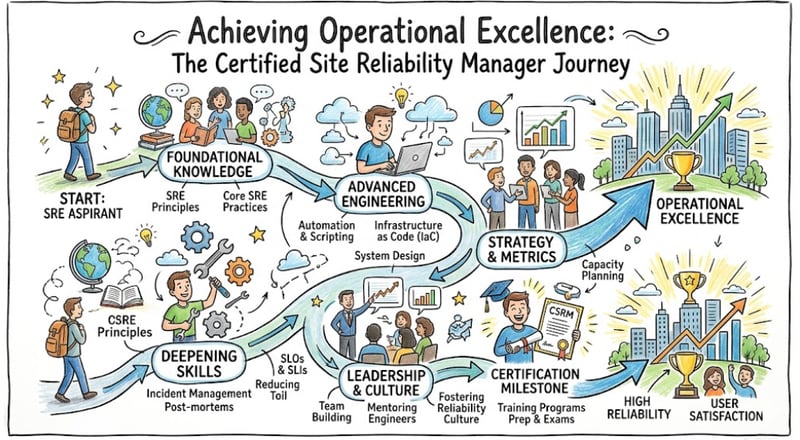
In an era where digital services are the lifeblood of business, downtime is no longer an option. For those managing high-scale systems, the Certified Site Reliability Manager program offers a robust roadmap for ensuring stability. By mastering the core tenets of reliability, engineers can foster a culture of resilience, a skill set honed through the expert resources provided by SREschool.com.
What is the Certified Site Reliability Manager?
The Certified Site Reliability Manager is a professional certification that focuses on the intersection of software development and large-scale systems operations. It teaches practitioners how to build systems that can withstand failures, scale under pressure, and remain reliable while undergoing constant change. It moves beyond manual maintenance, focusing instead on engineering solutions to operational challenges.
Who Should Pursue Certified Site Reliability Manager?
This certification is highly beneficial for professionals across the IT spectrum:
- System Administrators: Who are looking to adopt more modern, automated approaches to infrastructure.
- DevOps Professionals: Who want to sharpen their focus on the reliability aspect of the software lifecycle.
- Software Engineers: Interested in the performance and availability of their code in production environments.
- Infrastructure Managers: Who need to lead teams in establishing high-availability standards.
- Cloud Operations Specialists: Responsible for managing complex, multi-service cloud deployments.
Why Certified Site Reliability Manager is Valuable
Modern infrastructure is complex. A single point of failure can disrupt entire ecosystems. Professionals who hold the Certified Site Reliability Manager credential demonstrate that they possess the strategic mindset to manage this complexity. They understand how to prioritize reliability without stifling the velocity of feature releases, making them highly effective contributors in any engineering organization.
Certified Site Reliability Manager Certification Overview
This program is facilitated through an official course portal, ensuring that the material is current and directly applicable to real-world scenarios. It provides a structured learning environment where you can gain confidence in your ability to manage mission-critical systems through proven engineering methodologies.
Certified Site Reliability Manager Certification Tracks & Levels
The curriculum is tiered to support continuous professional development.
| Track | Level | Who it is for | Prerequisites | Skills Covered | Recommended Order |
|---|---|---|---|---|---|
| Foundations | Entry | Beginners | Basic Linux | Monitoring, SLOs | 1 |
| Professional | Mid-level | Engineers | Foundation Cert | Automation, Toil | 2 |
| Advanced | Senior | Leads | Professional Cert | Scaling, Resilience | 3 |
Detailed Guide for Each Certified Site Reliability Manager Certification
Foundations Level
- What it is: The essential starting point for reliability engineering.
- Who should take it: Those entering the SRE domain.
- Skills you will gain: Basic system observability and alerting principles.
- Real-world projects: Implementing a basic service monitoring setup.
- Preparation plan: 7 days.
- Common mistakes: Overlooking the basics of logging and diagnostics.
- Next certification: Professional Level.
Professional Level
- What it is: A comprehensive look at managing production systems.
- Who should take it: Experienced DevOps and SRE staff.
- Skills you will gain: Error budget management and automated recovery.
- Real-world projects: Writing and testing an incident response plan.
- Preparation plan: 30 days.
- Common mistakes: Focusing too much on tools rather than engineering processes.
- Next certification: Advanced Level.
Advanced Level
- What it is: Expert-level mastery of system architecture and failure analysis.
- Who should take it: Senior engineers and infrastructure architects.
- Skills you will gain: Disaster recovery architecture and capacity forecasting.
- Real-world projects: Designing a resilient multi-region infrastructure.
- Preparation plan: 60 days.
- Common mistakes: Trying to solve human issues with only technical tools.
- Next certification: Leadership tracks.
Choose Your Learning Path
- DevOps Path: Optimizing the bridge between development and operations.
- DevSecOps Path: Embedding security directly into reliable infrastructure.
- SRE Path: Maximizing system observability and performance engineering.
- AIOps Path: Leveraging intelligent systems for proactive monitoring.
- MLOps Path: Maintaining the reliability of machine learning models in production.
- DataOps Path: Streamlining the flow and reliability of data pipelines.
- FinOps Path: Balancing infrastructure uptime with financial efficiency.
Role → Recommended Certified Site Reliability Manager Certifications
| Role | Recommended Certifications |
|---|---|
| SRE Practitioner | Foundations + Professional |
| DevOps Engineer | Professional + Advanced |
| Systems Lead | Advanced |
| Operations Manager | Foundations |
Next Certifications to Take After Certified Site Reliability Manager
Once you have mastered the foundational and advanced reliability concepts, your next steps should align with your career goals, whether that means specializing in cloud security, AI operations, or moving toward high-level technical leadership.
Why Certified Site Reliability Manager Matters for Your Audience
For the professional community at ADXICT, uptime and performance are vital. The Certified Site Reliability Manager framework provides the technical vocabulary and procedural clarity needed to handle scale. By adopting these methods, you stop fighting fires and start engineering systems that effectively manage themselves, ensuring consistent quality for your users.
Training & Certification Support Providers for Certified Site Reliability Manager
DevOpsSchool focuses on practical, task-oriented training. Their programs are built on the premise that true expertise comes from handling real production challenges in a safe, laboratory environment. This ensures that their graduates are not just theorists, but engineers capable of managing reliable systems from day one.
Cotocus provides streamlined certification paths that help professionals build specific, high-demand skills quickly. They focus on the most impactful aspects of site reliability, making their training a great choice for those who need to improve their team's operational maturity without excessive classroom time.
Scmgalaxy is dedicated to the core methodologies of reliability engineering. They emphasize the importance of consistent processes and architectural soundness. Their training materials are well-structured, providing a clear path for professionals who want to understand the 'why' behind infrastructure stability.
BestDevOps serves as a practical hub for reliability knowledge. Their training approach focuses on the intersection of engineering and culture, helping individuals and teams move toward more resilient operations. They provide the necessary resources to help candidates prepare thoroughly for their certification goals.
DevSecOpsSchool brings a specialized perspective to reliability, emphasizing that secure systems are inherently more reliable. Their curriculum is essential for professionals working in environments where data integrity and uptime go hand-in-hand. They help bridge the gap between security and system availability.
SREschool.com stands out as a focused specialist in reliability education. Their programs are deep and comprehensive, designed for those who want to commit to a career path in SRE. They provide the industry-standard training that serves as the foundation for the Certified Site Reliability Manager credential.
AIOpsSchool addresses the modern challenge of monitoring at scale. By teaching engineers how to integrate AI into their operational workflows, they help reduce the cognitive load on engineering teams, allowing for more intelligent and predictive reliability management.
DataOpsSchool is focused on the reliability of the data layer. They provide the specialized training needed to ensure that data-heavy systems remain consistent and available, which is a major concern for modern businesses relying on real-time data processing.
FinOpsSchool teaches the critical skill of balancing system performance with costs. Their training helps you ensure that your reliability efforts are economically sustainable, providing the knowledge required to make smart architectural decisions in cloud-native environments.
Frequently Asked Questions (General)
- What is the primary aim of this program? To standardize and improve reliability practices.
- Is this a recognized certification? Yes, it is highly regarded within the global engineering community.
- Are there hands-on labs involved? Yes, practical application is a core part of the learning.
- Is this training suitable for developers? Yes, it helps developers understand production requirements.
- How long does the training process take? It varies based on the track and individual pacing.
- Are there prerequisites? A fundamental knowledge of Linux is generally expected.
- Can I complete this at my own pace? Yes, most platforms offer flexible study options.
- How is the exam administered? It is an online-based assessment.
- Will this improve my career prospects? Yes, it validates your specialized expertise.
- Is it a worthy investment? It is considered a key career-building credential.
- Is support available? Yes, most providers offer help if you encounter difficulties.
- Does the certificate expire? Periodic updates are usually recommended to stay current.
FAQs on Certified Site Reliability Manager (Focused)
- How is this different from standard DevOps? It places a specific focus on system availability.
- Does this teach incident management? Yes, it covers structured incident response frameworks.
- Is it relevant for cloud environments? It is designed specifically for modern cloud architectures.
- What are error budgets? They are a key mechanism for balancing risk and release speed.
- Is it suitable for small teams? The core principles are applicable to teams of any size.
- Is automation a focus? Yes, it is the primary way to reduce operational toil.
- How does it improve system uptime? Through proactive capacity planning and observability.
- Can I apply these concepts to older infrastructure? Yes, the principles are platform-agnostic.
Final Thoughts: Is Certified Site Reliability Manager Worth It?
The Certified Site Reliability Manager program is an excellent step for anyone looking to master the complexities of system uptime. It provides a clear, actionable framework that moves past theory into real-world operational excellence. For those dedicated to maintaining the health of modern infrastructure, this certification is a practical and highly valued asset.




Top comments (0)