
Introduction
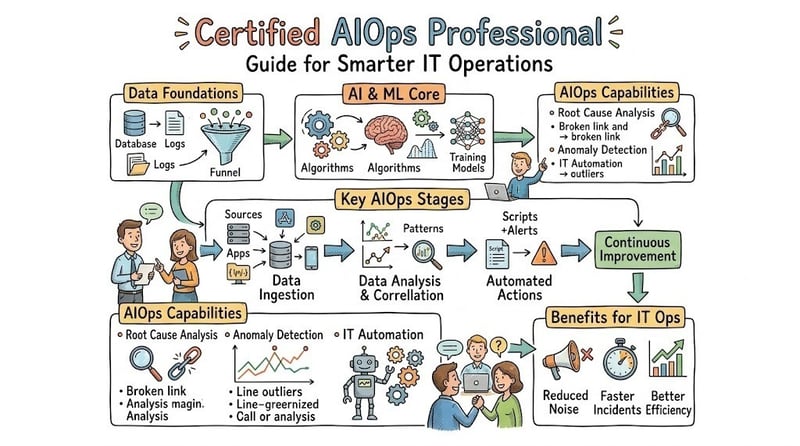
In today’s fast-paced IT landscape, organizations are embracing automation and AI-driven operations to stay competitive. The Certified AIOps Professional certification equips IT engineers, DevOps professionals, and managers with the skills needed to implement AIOps strategies effectively. This guide provides a comprehensive roadmap, helping professionals understand what this certification entails, its benefits, preparation strategies, and real-world applications.
Why this matters: Understanding AIOps capabilities is crucial for organizations aiming to reduce downtime, streamline incident management, and leverage predictive analytics.
What it is
The Certified AIOps Professional credential validates your expertise in applying artificial intelligence to IT operations. It focuses on integrating machine learning, automation, and analytics to improve system reliability, performance, and operational efficiency.
Why this matters: AIOps is not just a trend; it’s becoming a standard practice in modern IT environments for proactive issue resolution.
Who should take it
- IT engineers seeking to enhance operational efficiency
- DevOps and SRE professionals aiming to integrate AI in operations
- Managers responsible for IT infrastructure and system performance
- Software engineers interested in AI-driven operational analytics
Why this matters: The certification ensures that both technical and managerial professionals can leverage AIOps principles effectively in real-world scenarios.
Skills you’ll gain
- Implementing AI-driven monitoring and anomaly detection
- Automating incident response and root cause analysis
- Leveraging machine learning for predictive maintenance
- Integrating AIOps platforms with existing IT systems
- Using observability data for actionable insights
- Applying performance analytics for operational improvement
Why this matters: These skills empower professionals to anticipate issues before they impact users, improving service quality and reducing operational costs.
Real-world projects you should be able to do after it
- Design and deploy AI-based IT monitoring solutions
- Automate incident detection and response workflows
- Build predictive analytics models for IT operations
- Integrate AI-driven dashboards for cross-team collaboration
- Optimize cloud and on-premise resources using AIOps insights
Why this matters: Hands-on projects solidify knowledge and demonstrate your ability to apply AIOps concepts to real business problems.
Preparation plan
- 7–14 days: Focused overview of AIOps concepts, tools, and basic ML workflows.
- 30 days: Hands-on practice with AIOps platforms, implementing sample workflows, anomaly detection, and reporting.
- 60 days: Deep dive into predictive analytics, integration with CI/CD pipelines, and advanced automation scenarios.
Why this matters: Structured preparation ensures comprehensive coverage, from theory to practical implementation.
Common mistakes
- Ignoring integration with existing monitoring tools
- Overlooking the importance of data quality for ML models
- Failing to automate repeatable tasks, relying solely on manual intervention
- Neglecting performance and reliability metrics
- Focusing only on tools, not on actionable insights
Why this matters: Avoiding these pitfalls ensures successful AIOps adoption and operational efficiency.
Best next certification after this
- Certified MLOps Professional
- Certified DevOps Expert
- SRE Foundation or Advanced certifications
- Certified DataOps Professional
- FinOps Professional for cost optimization in cloud operations
Why this matters: Advancing your certifications allows career growth and deeper specialization in adjacent fields.
Choose your path
- DevOps: Enhance operational automation, CI/CD pipelines, and infrastructure reliability.
- DevSecOps: Integrate security into automated workflows using AI for threat detection.
- SRE: Focus on reliability engineering with predictive monitoring and proactive remediation.
- AIOps/MLOps: Build end-to-end AI-powered operational pipelines, combining ML with IT operations.
- DataOps: Manage operational data efficiently, improving quality and observability.
- FinOps: Optimize cloud spend and operational costs using AI analytics.
Why this matters: Tailored learning paths ensure professionals can align certification outcomes with their career goals.
Top institutions providing training and certifications for Certified AIOps Professional
- DevOpsSchool: Offers hands-on labs, practical assignments, and mentoring to ensure readiness.
- Cotocus: Focused on real-world scenarios with interactive sessions and case studies.
- Scmgalaxy: Provides blended learning and guided projects for skill reinforcement.
- BestDevOps: Emphasizes applied learning with access to virtual labs and tools.
- devsecopsschool: Integrates security automation and AI-driven operational insights.
- sreschool: Specializes in reliability engineering combined with AI analytics.
- aiopsschool: The official certification provider, delivering comprehensive training and official exam preparation.
- dataopsschool: Offers data-focused operational learning, essential for predictive analytics.
- finopsschool: Focuses on cost optimization and financial governance in AI-enabled operations.
Why this matters: Choosing the right institution ensures structured guidance, expert mentorship, and access to practical resources.
Conclusion
The Certified AIOps Professional certification equips IT and DevOps professionals with the tools, skills, and frameworks to drive AI-powered operational excellence. By mastering monitoring, automation, and predictive analytics, you can improve system reliability, enhance performance, and proactively prevent incidents. Structured preparation, understanding real-world applications, and avoiding common mistakes are crucial for success. Leveraging the learning paths and top training institutions ensures you gain both theoretical knowledge and practical expertise. For engineers and managers aiming to transform IT operations, this certification is a strategic step toward a future-ready career.


Top comments (0)