
Unlocking your true financial potential in the modern tech ecosystem requires a clear, data-driven strategy. Silicon Valley tech firms, European enterprise banks, and fast-growing remote startups all use complex, hidden formulas to determine payroll budgets for engineering talent. This reality leaves many talented system engineers relying on guesswork and outdated forum posts when negotiating their career offers.
Astute professionals overcome this challenge by feeding their personal technical profiles into an analytical DevOps Salary Calculator. This sophisticated modeling system decodes corporate compensation frameworks, transforming confusing benefits data into clear, actionable market targets. The following blueprint breaks down the exact operational components, regional regulations, and negotiation strategies you need to maximize your market value and command elite compensation packages globally.
What Is a DevOps Salary Calculator?
The Core Purpose of DevOps Salary Calculator
This advanced forecasting framework establishes financial transparency across the software engineering industry. For too long, corporate human resource departments have held an unfair advantage by hiding salary data behind proprietary, invite-only compensation databases. By gathering, validating, and publishing real-world compensation metrics across diverse regions, this data tool breaks down corporate information monopolies. This democratization allows engineering candidates to anchor their career negotiations in verifiable market facts rather than hopeful estimates.
How the DevOps Salary Calculator System Works
The tool's underlying algorithm processes candidate capabilities through a dynamic, multi-dimensional pricing matrix. Initially, the engine establishes a localized economic baseline by assessing regional cost-of-living metrics, local tax brackets, and employment laws. Next, it cross-references your technical stack against real-time talent supply indexes to identify niche skill premiums. Finally, the system factors in corporate operational scales, active funding rounds, and architecture complexities to generate a highly precise, personalized market value projection.
Eligibility Standards vs. Selection Criteria
Squeezing the absolute maximum financial return from your next career move requires you to understand the sharp division between baseline qualifications and competitive hiring advantages. Eligibility standards merely represent the basic requirements needed to survive initial human resource screenings, such as a standard university degree or basic scripting skills. Selection criteria, on the other hand, dictate your ultimate placement within a company's highest salary bands. Hiring managers award premium compensation specifically to engineers who demonstrate a proven history of managing massive multi-region platforms, lowering cloud spend, and leading high-pressure incident response teams.
Age Factors in DevOps Salary Calculator
In this analytical framework, age has absolutely nothing to do with biological longevity; rather, it measures your technical tenure keeping production environments alive through major architectural shifts. The evaluation software tracks how many continuous years you have sustained live systems during high-stakes data migrations or multi-region infrastructure overhauls. Because enterprises pay top dollar to minimize system downtime, deep operational tenure serves as concrete proof that you know how to protect revenue streams, which immediately raises your score in the calculation engine.
Educational Evaluation for DevOps Salary Calculator
The evaluation system measures your educational foundation by tracking your commitment to continuous, high-impact upskilling over your static academic history. While a standard computer science degree establishes initial professional credibility, advanced cloud architecture certifications deliver much faster, more predictable compensation spikes. The engine continually balances your historical academic background against your modern technical validations to ensure your profile matches up with today's highest-paying engineering roles.
Performance Standards and Benchmarks
Modern tech companies focus their largest payroll budgets on engineers who continuously hit high-performance operational milestones. The estimation system ignores basic, everyday maintenance tasks, evaluating instead your direct, measurable impact on platform reliability metrics:
- Mean Time to Detection (MTTD): Your speed in identifying infrastructure anomalies before they impact end users.
- Pipeline Success Rate: Your accuracy in building automated deployment systems that minimize code delivery failures.
- Service Level Indicators (SLIs): Your compliance with strict, contractually guaranteed system performance targets.
Professional Experience Verification
The final core building block evaluates the concrete size, scale, and data traffic volume of your previous cloud environments. Orchestrating distributed container networks that process millions of real-time transactions commands a vastly superior salary scale than managing standard virtual testing boxes. Consequently, the verification engine looks deeply at your past hands-on management of complex multi-cloud networks, automated disaster recovery models, and global content delivery setups.
Primary Frameworks Governing DevOps Salary Calculator
The Detailed Score Breakdown
To produce a highly accurate salary projection, the system weights your engineering profile across four key operational pillars. Your mastery of these specific quadrants dictates your final position within global technology compensation curves.
| Assessment Component | Evaluation Focus | Total Weight Multiplier |
|---|---|---|
| Cloud Native Orchestration | Declartive infrastructure-as-code, container topologies, immutable meshes | 30% |
| Telemetry & Incident Command | Proactive anomaly detection, distributed trace capture, rapid root-cause analysis | 25% |
| Supply Chain Protection | Automated image scanning, secrets management, continuous edge security | 25% |
| Financial Operations (FinOps) | Dynamic resource lifecycle management, asset rightsizing, cloud efficiency | 20% |
Real-World Application Scenarios
Reviewing these contrasting professional paths illustrates exactly how the evaluation framework shifts compensation values:
- The Basic Automation Administrator: A worker spends their time writing simple, repetitive scripts to handle local user permissions and static test environments. Because basic automation tools have commoditized this work, the software applies a standard baseline modifier, keeping compensation within ordinary market averages.
- The Cloud Infrastructure Architect: A specialist designs resilient, automated developer platforms that eliminate manual deployment friction across thousands of core microservices. Because this architecture directly boosts feature delivery speeds, the framework triggers maximum salary multipliers and elite equity considerations.
International Pathways for DevOps Salary Calculator
Key Categories and Classes
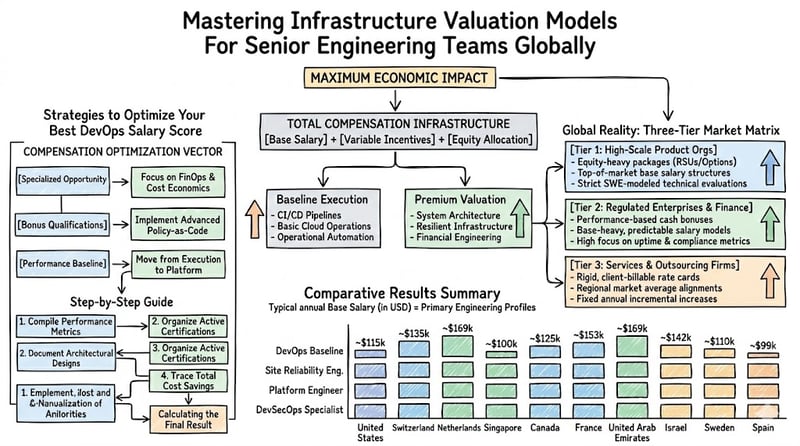
To properly account for a highly globalized, remote engineering workforce, the analytics engine separates engineering positions into three distinct operating classes. Each functional group carries its own unique compensation ceilings and day-to-day business expectations.
- High-Compliance Enterprise Environments: Highly regulated fields like banking, aviation, and healthcare that prioritize deep audit protection, zero-downtime scaling, and ironclad data security.
- High-Velocity SaaS Frameworks: Fast-moving digital product companies that demand rapid deployment cycles, massive daily active user traffic, and continuous system optimization.
- Strategic Cloud Consultancies: Client-facing advisory firms that prioritize multi-tenant architecture rollouts, rapid proof-of-concept building, and diverse cloud tool integrations.
Comparative Results Summary
The total market value of your systems engineering skillset shifts based on how your target industry category captures revenue. High-velocity SaaS platforms consistently award the largest overall compensation packages—blending high base pay with valuable stock options—because platform outages instantly result in direct revenue losses. Conversely, high-compliance enterprise environments protect talent with immense stability, offering highly competitive base salaries paired with predictable yearly bonuses and rich corporate retirement matches.
Advanced Regional Requirements for DevOps Salary Calculator
Securing elite-tier global compensation requires you to develop a deep understanding of hyper-local regulatory mandates and geographic compliance frameworks. Because engineering expectations shift significantly across international borders, you must match your specific technical skills to these regional priorities.
In North American hiring markets, enterprise tech teams focus heavily on your ability to scale large systems while maintaining strict compliance with security frameworks like SOC2 or FedRAMP. Compensation structures in this region lean heavily toward aggressive total cash values, pairing high base salaries with stock options that carry significant wealth-generation upside. However, turning your attention to Euro-zone markets reveals a completely different corporate landscape. European organizations place supreme value on data privacy under GDPR, mandatory work-life balance rules, and strong collective bargaining protections. As a result, calculation engines for these European regions often yield lower upfront base cash figures, but compensate for this with extensive parental leave, subsidized health coverage, and deep job protection.
Transitioning into the Asia-Pacific tech corridors introduces an entirely different set of variable conditions. In major financial centers like Singapore or Sydney, government watchdogs strictly enforce operational resilience guidelines like the MAS and APRA frameworks. Engineers who demonstrate a verified history of building systems that comply with these regional rules secure massive compensation premiums. Furthermore, many local government entities mandate specialized security clearances for sovereign cloud data management, creating a small pool of qualified talent that keeps compensation levels exceptionally high.
The Global Landscape of DevOps Salary Calculator
The reference table below details the annual base salary distributions across primary international tech hubs. These figures represent current, full-time base compensation baselines, completely excluding volatile stock grants and variable performance bonuses.
| Country Hub | Local Currency | Junior Band (Min / Max) | Mid-Level Band (Min / Max) | Senior Band (Min / Max) |
|---|---|---|---|---|
| United States | USD | $75,000 / $95,000 | $92,000 / $143,000 | $145,000 / $220,000 |
| Switzerland | CHF | 90,000 / 115,000 | 114,000 / 179,000 | 180,000 / 240,000 |
| Netherlands | EUR | 55,000 / 72,000 | 71,000 / 111,000 | 112,000 / 165,000 |
| Singapore | SGD | 56,000 / 72,000 | 71,000 / 111,000 | 112,000 / 170,000 |
| United Kingdom | GBP | 40,000 / 55,000 | 54,000 / 85,000 | 86,000 / 135,000 |
| Canada | CAD | 53,000 / 68,000 | 66,000 / 104,000 | 105,000 / 155,000 |
| Germany | EUR | 48,000 / 62,000 | 60,000 / 95,000 | 96,000 / 140,000 |
| Australia | AUD | 65,000 / 85,000 | 84,000 / 130,000 | 131,000 / 195,000 |
| United Arab Emirates | AED | 50,000 / 65,000 | 63,000 / 98,000 | 99,000 / 160,000 |
| India | INR | 6,00,000 / 9,50,000 | 12,00,000 / 22,00,000 | 25,00,000 / 45,00,000 |
Benefits of Utilizing a DevOps Salary Calculator
Cost Efficiency for Career Development
Relying on a structured valuation index prevents you from wasting valuable time and financial resources on unvalued skill sets. Instead of blindly collecting basic certifications or signing up for general coding bootcamps, you focus your study hours on the exact technical frameworks that drive actual salary growth. This surgical approach ensures that every dollar and hour you invest in your career translates directly into higher earning power.
Instant Reality Checks
The modern tech job market contains an immense amount of misleading, inflated compensation data. Corporate recruiters frequently advertise massive, unrealistic salary bands to attract top applicants, while online tech forums often highlight extreme stock outliers that distort true market conditions. A dedicated calculator gives you an immediate, realistic checkpoint. It anchors your career expectations in verified, data-backed distributions, giving you the confidence to decline low offers and set realistic negotiation goals.
Strategic Long-Term Planning
True career acceleration requires you to look far beyond your next immediate job change. By testing different variables inside the evaluation tool, you can plan out a highly profitable multi-year professional road map. You can easily visualize exactly how your market value spikes if you transition from a standard developer into an advanced platform architect, a Site Reliability Specialist, or an infrastructure engineering manager. This strategic foresight allows you to build your technical skills around where future market demand is growing.
Step-by-Step Guide to Mastering DevOps Salary Calculator
To unlock the maximum potential of your engineering career and systematically secure elite global compensation packages, follow this step-by-step implementation plan.
1. Gathering Necessary Documents
Begin by compiling your complete technical history into an objective, data-backed portfolio. Collect your previous performance reviews, explicit records of cloud computing budgets you have managed, and detailed uptime metric reports. Additionally, organize all your active cloud architecture credentials, university degrees, and formal employment letters that verify your historic corporate leveling grades.
2. Practicing the Core Assessments
Conduct a thorough, honest self-assessment of your hands-on coding capabilities across primary infrastructure disciplines. Spend time building complex infrastructure-as-code automation, diagnosing broken distributed service networks under tight timelines, and deploying automated multi-region failover structures. Because top-paying enterprises run rigorous technical loops, keeping your practical skills sharp ensures your live interview performance matches your calculated salary potential.
3. Checking Market Demand Lists
Cross-reference your current technical toolset with real-time global talent shortage records and platform demand indexes. Look closely for emerging multi-cloud architectural trends where enterprises face severe talent deficits. If your current skillset relies on older, commoditized tools, identify the modern, cloud-native platforms you need to learn to shift your profile into a premium compensation tier.
4. Adding Secondary Factors
Incorporate key environmental variables into your personal valuation model to refine your ultimate salary targets. Factor in your remote-work configurations, geographic location boundaries, and your willingness to handle demanding production on-call schedules. Additionally, evaluate the financial performance and funding stages of your target enterprise industries, as these factors directly dictate an organization's ultimate capacity to pay premium wages.
5. Calculating the Final Result
Input your fully compiled profile metrics into the calculation engine to generate your precise compensation benchmark target. Analyze the resulting distribution models, paying close attention to the clear divides between entry-level, median, and elite-tier salary bands for your experience level. Use this definitive financial baseline as your absolute anchor point when speaking with recruiters, talent acquisition leads, and engineering directors.
The Performance Enhancement Strategy
The most effective way to shift your profile from standard market medians into maximum compensation brackets is to master complex, specialized infrastructure domains. Stop presenting yourself as a generic systems administrator who handles simple script tasks and basic pipeline configurations. Instead, master premium disciplines like multi-region service mesh deployments, automated compliance-as-code engines, and advanced distributed telemetry platforms. When you conquer these difficult technical spaces, you escape crowded talent pools and enter an elite space where enterprises routinely lift standard salary caps to secure your services.
Bonus Qualification Advantages
Accelerating your professional value requires you to collect advanced credentials that instantly prove your technical depth to automated HR screening systems. Prioritize earning professional-grade cloud architect credentials alongside rigorous hands-on certifications like the Certified Kubernetes Administrator (CKA) designation. These elite credentials validate your infrastructure capabilities on sight, fast-tracking your applications past initial hiring steps and justifying top-tier starting salary offers.
Specialized Opportunity Pathways
True wealth creation in systems engineering comes from intentionally targeting high-risk business sectors where platform downtime carries severe financial or regulatory penalties. Focus your career on taking ownership of high-frequency trading networks, sovereign enterprise clouds, or massive healthcare telemetry platforms. Because these fields face intense compliance audits and significant revenue risks, they are structurally engineered to pay massive premiums for engineering talent that can guarantee platform reliability.
Common Mistakes in the DevOps Salary Calculator Process
- Confusing Basic Tool Exposure with Deep Mastery: Many engineers assume that running a few basic software commands makes them an expert. True market value requires you to prove you have deployed, scaled, and repaired that technology across large, live production systems.
- Selecting Inaccurate Job Classification Codes: Inputting generic or outdated engineering titles into market valuation systems produces highly skewed data results. Always align your research profile with modern, high-value industry labels like Platform Engineer or Site Reliability Specialist.
- Presenting an Outdated Skills Portfolio: Relying on expired certifications or obsolete infrastructure tools misrepresents your current market value. The systems ecosystem shifts rapidly, meaning you must continuously update your portfolio with active, modern credentials.
- Overlooking Local Purchasing Realities: Evaluating gross base salary figures without calculating local income tax scales, inflation rates, and housing costs leads to poor career choices. A lower gross salary in a tax-advantaged region often yields higher disposable wealth than a massive salary in an expensive urban center.
Real-Life Case Scenarios Using DevOps Salary Calculator
The Early Career Scenario
A tech newcomer enters the infrastructure field with basic configuration knowledge and two years of general helpdesk support experience. Initially, their profile metrics place them in a low-tier salary bracket. However, by executing a targeted upskilling strategy, they learn modern container tools and earn foundational cloud architecture credentials. Within two years, this focused approach raises their valuation score, helping them land a mid-level platform engineering role with a significant salary increase.
The Experienced Professional Scenario
A legacy systems engineer spends eight years managing on-premises hardware stacks for a regional retail corporation. Although they possess deep foundational networking knowledge, their lack of modern cloud-native systems expertise keeps their compensation stuck at local averages. To break through this ceiling, they use an evaluation tool to identify skill premiums, revealing a massive market demand for container orchestrators. They master Kubernetes systems, re-enter the job market as a Senior Reliability Engineer, and instantly break into a premium compensation bracket.
The Specialized Hero Scenario
An elite systems architect holds advanced expertise in both deep cloud security automation and corporate cloud cost optimization (FinOps). Running their experience profile through a global calculator generates maximum score multipliers across every single category. Armed with this verifiable proof of their extreme market scarcity, they bypass standard corporate job boards entirely. They negotiate directly with executive technology leadership, securing a principal architect position at the absolute pinnacle of global technology compensation.
Frequently Asked Questions (FAQs)
How do enterprise companies handle base salary negotiations for fully remote platform engineers?
Most global enterprises implement one of two distinct remote payroll strategies: they either match your base pay to local cost-of-labor indexes, or they establish a single, flat salary tier based on corporate headquarters. The calculation tool adjusts its final outputs based on which model your target employer uses.Will learning advanced programming languages like Go or Rust boost my infrastructure salary score?
Yes, mastering systems programming languages shifts your profile from a traditional tool administrator to a highly valuable platform software engineer. This capability allows you to build custom infrastructure platforms internally, which commands a massive salary premium over simply configuring third-party tools.Does the calculator consider equity vesting schedules when projecting total compensation?
The core estimation module focuses primarily on predictable base cash salaries because startup equity models vary wildly based on corporate growth stages. However, the system provides detailed guidelines on standard equity grant percentages based on company valuation milestones.Why do site reliability roles frequently outearn standard systems administration positions?
Site Reliability Engineering roles command premium valuations because their day-to-day work is tied directly to protecting corporate revenue streams and maintaining strict platform uptime. This clear connection to business outcomes naturally pushes their salary bands higher.Can I use the tool's generated data to negotiate an internal promotion raise?
You can absolutely leverage the output data as objective market proof during internal salary reviews. Present the distribution curves to your manager to show how your upgraded technical skill set and expanded system scale ownership match top-tier market values.What role do open-source software contributions play in driving up my calculated value?
Maintaining or contributing to major open-source infrastructure tools functions as an elite verification factor that proves your technical mastery to global hiring teams. The system flags this high-profile work, often pushing your profile into non-standard salary bands.How does the calculation engine account for intensive on-call infrastructure rotations?
The software overlays industry-standard lifestyle multipliers to account for demanding 24/7 production ownership. Positions that require heavy on-call rotations typically balance that stress with elevated base salaries or structured shift-differential bonuses.Should I accept a lower base cash offer if a company promises massive performance bonuses?
This depends on your immediate financial stability and how transparently the company measures its performance metrics. Ground your negotiation strategy in a competitive base salary, as bonuses remain variable and are never fully guaranteed.Does mastering multiple cloud ecosystems yield a higher value than specializing in one?
While multi-cloud knowledge is valuable for enterprise consulting roles, deep specialization in one major cloud ecosystem usually generates a higher initial salary premium than shallow knowledge spread across multiple platforms.How rapidly does changing macroeconomic demand alter the calculator's core data models?
The underlying analytics system continuously updates its core matrix by importing real-time hiring metrics, active job postings, and corporate budget updates. This constant data ingestion ensures your salary projections stay accurate during changing market conditions.
Conclusion
Securing your true financial worth in the global technology marketplace requires moving past guesswork and adopting a data-backed negotiation strategy. By identifying the exact operational metrics, regional compliance rules, and specialized toolsets that drive employer demand, you take total control of your professional value. Utilizing a dedicated DevOps Salary Calculator gives you the precise insights needed to eliminate information gaps, optimize your skills portfolio, and approach negotiations with complete confidence.
Ultimately, top-tier compensation rewards those who transform infrastructure from a corporate expense into a powerful competitive advantage. Focus on mastering complex distributed systems, taking ownership of critical production stability, and using verified market data to achieve your ultimate earning potential.




Top comments (0)