
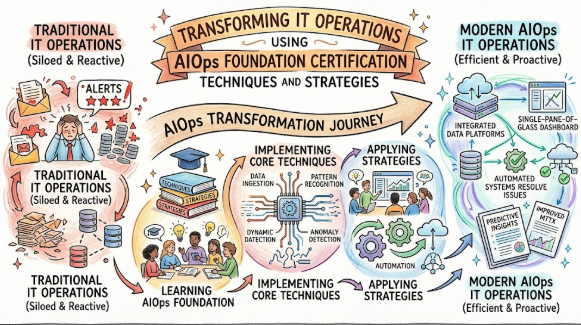
Introduction
Modern enterprise infrastructure has become highly complex and distributed. Traditional monitoring tools are no longer sufficient to handle the massive volume of alerts, logs, and telemetry data generated by cloud-native systems. This is where Artificial Intelligence for IT Operations becomes essential. Systems are kept stable through the automated detection of anomalies and rapid root cause analysis. To establish structured authority in this domain, formal validation is required by modern professionals.
A structured career path in modern system operations is established by validating skills through professional credentials. For engineers working across India and global markets, the transition from reactive firefighting to proactive automation is supported by this framework. A clear educational pathway is provided by this guide to master the fundamental principles of artificial intelligence within IT infrastructure. Complex operational challenges are simplified through these structured methodologies.
What is AIOps Foundation Certification
The AIOps Foundation Certification is an entry-level professional credential designed to validate an individual's understanding of artificial intelligence and machine learning applications within IT operations. Basic terminology, core architectures, and data ingestion processes are covered under this curriculum. It is ensured that individuals understand how algorithmic patterns are utilized to automate regular operation tasks.
Knowledge regarding multi-source data ingestion, baseline anomaly detection, and automated event correlation is tested by this certification program. The fundamental shift from manual dashboard monitoring to algorithmic operational awareness is addressed. A standardized baseline of knowledge is provided across engineering teams so that collaborative infrastructure automation can be executed seamlessly.
Why it matters today’s ?
Infrastructure scales at a pace that cannot be managed by human operators alone. Millions of events are generated every second across microservices, hybrid clouds, and containerized deployments. Critical issues are often missed due to alert fatigue and disconnected monitoring systems. Large enterprise systems are protected from unexpected downtime through the application of machine learning models.
Operational costs are significantly reduced when automated root cause analysis is deployed across business infrastructure. Mean time to resolution is minimized, and system reliability is maintained at an optimal level. Enterprises in global markets are actively shifting toward algorithmic operations to remain competitive. Knowledge in this specific domain is required to keep pace with these modern business infrastructure demands.
Why AIOps Foundation Certification certifications are important
Standardized validation of modern skills is provided to employers through formal certifications. Theoretical knowledge is transformed into structured, practical understanding that can be applied directly to enterprise environments. When IT professionals are certified, a shared vocabulary and operational methodology are established across distributed global engineering teams.
Career growth is accelerated because market demand for automated operations continues to rise rapidly. Hiring risks are minimized for engineering managers when validated skillsets are identified during recruitment. The ability to design, deploy, and maintain intelligent monitoring pipelines is verified through this foundational testing process.
why choose AIOps School ?
Comprehensive and highly structured educational resources are provided by AIOps School to meet global industry requirements. The curriculum is regularly updated to reflect real-world engineering challenges and modern algorithmic operational shifts. A practical balance between core data science concepts and actual infrastructure engineering needs is maintained by the institution.
High-quality preparation paths are delivered through well-designed testing structures that accurately evaluate professional competency. Learning is supported by comprehensive conceptual breakdowns that cater to both beginners and seasoned platform engineers. Global standard validation is achieved by professionals who utilize this dedicated platform for their educational advancement.
Certification Deep-Dive
What is this certification?
The AIOps Foundation Certification is a fundamental validation program that certifies an individual's core understanding of machine learning applications within IT operational pipelines. Core concepts of telemetry data aggregation, algorithmic noise reduction, and automated incident remediation are verified by this credential.
Who should take this certification?
- Working Software Engineers seeking to understand automated system behavior and telemetry analysis.
- DevOps, Cloud, and Platform Engineers who want to move away from manual threshold alerts toward algorithmic alerts.
- Site Reliability Engineers tasked with improving system availability and reducing mean time to resolution.
- Engineering Managers who need to oversee the deployment of intelligent operational platforms within their teams.
Certification Overview Table
| Track | Level | Who it’s for | Prerequisites | Skills Covered | Recommended Order |
|---|---|---|---|---|---|
| AIOps Foundation | Foundational | DevOps Engineers, SREs, System Administrators | Basic understanding of IT operations and monitoring concepts | Data ingestion, event correlation, anomaly detection basics | First |
| AIOps Professional | Intermediate | Platform Engineers, Senior DevOps, Data Engineers | AIOps Foundation Certification completed | Model training, pipeline design, telemetry aggregation | Second |
| AIOps Expert | Advanced | Principal SREs, Infrastructure Architects | AIOps Professional Certification completed | Enterprise architecture design, multi-cloud algorithmic orchestration | Third |
| AIOps Leadership | Management | Engineering Managers, Directors of IT, CIOs | Basic technical awareness of infrastructure concepts | Strategic implementation, ROI calculation, team structuring | Optional / Concurrent |
Skills you will gain
- Understanding of structured and unstructured telemetry data extraction across distributed platforms.
- Knowledge regarding the application of mathematical algorithms for noise elimination in alert systems.
- Ability to configure baseline anomaly detection parameters for microservices.
- Competency in mapping automated event correlation paths to accelerate root cause diagnostics.
- Familiarity with the integration of predictive analytics within standard incident management tools.
Real-world projects you should be able to do after this certification
- Design an automated log aggregation pipeline that categorizes system anomalies using algorithmic filters.
- Configure an event correlation matrix that groups thousands of separate infrastructure alerts into single, actionable incidents.
- Build a predictive dashboard that identifies potential storage and memory exhaustion patterns before failures occur.
- Implement an automated remediation script triggered by verified machine learning alerts to restart failing services safely.
Preparation plan
7–14 days plan
Core terminology and foundational concepts are focused upon during this brief period. Two hours are dedicated daily to reviewing the primary modules of the certification blueprint. Basic definitions of telemetry data, event correlation, and noise reduction are memorized. Standard practice questions are solved during the final three days to ensure exam structure familiarity.
30 days plan
A systematic division of topics is executed across four weeks. The first two weeks are utilized to master data ingestion techniques and algorithmic patterns. The third week is dedicated to understanding real-world operational use cases and automated remediation workflows. The final week is entirely reserved for exhaustive mock examinations and weak area rectification.
60 days plan
Deep conceptual understanding and practical alignment are prioritized over this extended timeframe. The first month is spent studying the intersection of operational telemetry and machine learning theory. Practical exploration of monitoring dashboards and alert pattern configurations is conducted during weeks five and six. The remaining two weeks are focused on advanced question analyses and comprehensive revision.
Common mistakes to avoid
- The importance of understanding core statistical terms used in data analysis is often ignored by candidates.
- Preparation is focused entirely on theoretical definitions without reviewing practical infrastructure application scenarios.
- Mock examinations are skipped, which leads to poor time management during the actual certification exam.
- The differences between traditional threshold-based alerts and algorithmic anomaly detection are frequently confused.
Best next certification after this
- Same track: The AIOps Professional Certification is recommended to gain deeper expertise in operational model configuration.
- Cross-track: The MLOps Foundation Certification can be pursued to understand the complete lifecycle of machine learning deployment.
- Leadership / management: The AIOps Certified Leader program is suitable for transitioning into strategic operational governance.
Choose Your Learning Path
DevOps Learning Path: This path is designed for engineers who want to insert intelligent testing and automated feedback loops into continuous integration pipelines. Automated deployment analysis is mastered to reduce post-release failures. It is ideal for application delivery professionals.
DevSecOps Learning Path: This structure is tailored for security-focused engineers who want to apply automated anomaly detection to security log analysis. Real-time threat patterns are identified using machine learning. It is best suited for compliance and security automation professionals.
Site Reliability Engineering (SRE) Learning Path: This path is focused on maximizing system uptime and automating root cause analysis for complex incidents. Large-scale distributed alert management is simplified through algorithmic classification. It is ideal for operational sustainability experts.
AIOps / MLOps Learning Path: This roadmap is created for engineers who manage the production lifecycles of machine learning models alongside standard IT operations. Consistent monitoring of model drift and data lineage is maintained. It is perfect for data science operations professionals.
DataOps Learning Path: This sequence is optimized for professionals who manage large-scale data pipelines and data quality monitoring systems. Data flow anomalies are detected automatically before analytics layers are corrupted. It is intended for data platform engineers.
FinOps Learning Path: This path is structured for professionals who focus on cloud cost optimization and algorithmic anomaly detection within billing cycles. Wasteful infrastructure spending is identified automatically. It is best for cloud financial management specialists.
Role → Recommended Certifications Mapping in table
| Target Professional Role | Recommended Primary Certification | Secondary Validation Track |
|---|---|---|
| DevOps Engineer | AIOps Foundation Certification | DevOps Professional Credentials |
| Site Reliability Engineer (SRE) | AIOps Foundation Certification | SRE Advanced Architecture |
| Platform Engineer | AIOps Foundation Certification | Cloud Infrastructure Expert |
| Cloud Engineer | AIOps Foundation Certification | Multi-Cloud Operations Foundation |
| Security Engineer | AIOps Foundation Certification | DevSecOps Automation Track |
| Data Engineer | AIOps Foundation Certification | DataOps Foundation Track |
| FinOps Practitioner | AIOps Foundation Certification | FinOps Cost Optimization Track |
| Engineering Manager | AIOps Foundation Certification | AIOps Leadership Strategy |
Next Certifications to Take
One same-track certification: The AIOps Professional Certification is selected as the immediate next step to deepen knowledge in advanced configuration. Practical data aggregation mechanics and multi-layered event correlation strategies are mastered within this curriculum. Architectural design capabilities for enterprise automation platforms are expanded by it.
One cross-track certification: The Site Reliability Engineering Professional credential is pursued to merge algorithmic monitoring knowledge with core infrastructure reliability principles. High-availability system patterns and error budget management are thoroughly understood through this educational cross-over. Complete operational resilience is achieved across cloud platforms.
One leadership-focused certification: The AIOps Certified Leader program is chosen by professionals moving toward strategic operational management roles. Financial planning for infrastructure tools, team structural design, and large-scale automation adoption metrics are covered under this syllabus. Long-term organizational technology transformations are successfully guided by it.
Training & Certification Support Institutions
DevOpsSchool: Comprehensive instructor-led training programs are delivered by this institution to support global professionals. Deep practical labs and structured study guides are provided to ensure successful examination preparation. Technical guidance is maintained by experienced industry educators.
Cotocus: Customized corporate training and technical learning support are offered across multiple operational tracks. Specialized training material aligned with current market requirements is delivered systematically. Conceptual mastery is emphasized over rote learning patterns.
ScmGalaxy: A wide range of educational resources, community forums, and practice tests are hosted by this platform. Candidates are assisted in understanding complex configuration challenges through simple instructional methodologies. Career preparation paths are strengthened by their extensive knowledge base.
BestDevOps: Focused bootcamps and intensive training formats are provided for modern infrastructure operational methodologies. Learning paths are structured to maximize knowledge retention and accelerate professional skill acquisition. Practical real-world scenarios are integrated within their teaching structures.
devsecopsschool.com: Dedicated educational pathways focusing on the intersection of infrastructure security and automated workflows are provided. Secure pipeline design principles and compliance monitoring methods are systematically taught. Practical threat analysis concepts are prioritized.
sreschool.com: Specialized operational training programs designed to build high-availability system maintenance skills are delivered. System resilience metrics, incident handling protocols, and error budget calculations are covered. Engineering reliability is emphasized throughout the coursework.
aiopsschool.com: Official validation and comprehensive foundational training material are provided directly through this dedicated ecosystem. Algorithmic operational structures, machine learning fundamentals, and telemetry ingestion designs are taught. Complete preparation paths for modern infrastructure certifications are hosted here.
dataopsschool.com: Focused training paths regarding automated data pipeline management and data infrastructure optimization are delivered. Data quality monitoring and automated lifecycle workflows are deeply explored. Architectural pipeline stability is prioritized.
finopsschool.com: Comprehensive educational support centered on cloud financial management and algorithmic cost analysis is provided. Cloud budget optimizations, waste detection patterns, and cross-departmental accountability structures are covered. Financial clarity within infrastructure operations is emphasized.
FAQs Section
What is the difficulty level of the entry exam?
The examination is structured at a foundational level, which makes it highly accessible to individuals possessing basic IT operations awareness. Steady study ensures success.
How much time is required to prepare for this test?
A period of two to four weeks is generally sufficient if study materials are reviewed consistently for one to two hours daily.
Are there any mandatory technical prerequisites required before taking the exam?
No formal technical certifications are required, but a basic understanding of operating systems and standard monitoring tools is highly recommended.
What is the recommended certification sequence in this track?
The path is commenced with the foundation level, followed sequentially by the professional certification, and completed at the expert level.
What long-term career value is offered by this credential?
Professional credibility is enhanced, and validation of automated infrastructure management skills is provided to global recruiters.
Which job roles are expanded after achieving this certification?
Growth is observed in roles such as DevOps Specialist, Site Reliability Engineer, Cloud Infrastructure Architect, and Platform Team Lead.
Is the exam conducted in an online proctored format?
Yes, the testing process can be completed from any global location through the official web portal provided security requirements are met.
How long does the certification remain valid after passing?
The status remains active permanently, though supplementary continuous education units can be pursued to track industry upgrades.
Are mock examinations provided during the preparation support phase?
Yes, practice evaluation frameworks are supplied by authorized training institutions to measure preparation levels accurately.
Does this curriculum cover specific vendor software products?
No, the educational focus is kept vendor-neutral so that universal architectural principles can be applied across any corporate tooling environment.
How does this training impact daily engineering responsibilities?
Manual troubleshooting efforts are significantly reduced as automated anomaly recognition patterns are systematically integrated into workflows.
Can engineering managers benefit from this foundational syllabus?
Yes, clear strategic oversight regarding tool selection and operational team transformation is developed through this course.
1. What specific concepts are tested under the AIOps Foundation Certification?
Core evaluation is focused on telemetry data ingestion frameworks, alert noise reduction algorithms, and baseline anomaly detection mechanics.
2. Is data science experience required for the AIOps Foundation Certification?
No, advanced mathematical modeling is not required; only the operational application of machine learning concepts is tested.
3. How does the AIOps Foundation Certification improve system incident management?
The knowledge verified allows engineers to group disjointed infrastructure alerts into correlated events, which accelerates root cause analysis.
4. Where can the registration portal for the AIOps Foundation Certification be accessed?
The registration process is managed directly through the official website at aiops-foundation-certification.
5. What type of questions are encountered during the AIOps Foundation Certification exam?
The evaluation consists of multiple-choice questions that assess conceptual clarity and scenario-based operational problem-solving.
6. Can team agility be enhanced by completing the AIOps Foundation Certification?
Yes, operational transparency is increased across engineering departments when an algorithmic infrastructure baseline is established.
7. Is the AIOps Foundation Certification recognized by international enterprise employers?
Yes, the validation framework is acknowledged across global tech hubs including India, Europe, and North American markets.
8. What is the main differentiator of the AIOps Foundation Certification compared to basic DevOps courses?
Continuous integration automation is the main focus of DevOps, whereas algorithmic data analytics and automated system remediation are prioritized by this program.
Testimonials
The perspective regarding alert management was completely transformed after completing this course. Redundant notification noise has been successfully removed from our platforms.
- Aarav
Root cause diagnosis times were cut in half using the event correlation models learned here. Complete clarity has been brought to our system monitoring setup.
- Deepak
Career transition plans into modern platform infrastructure roles were validated by this step. Confidence was significantly boosted during technical recruitment discussions.
- Elena
Automated security anomaly tracking was successfully deployed within cloud architecture using these principles. System threat detection capabilities have improved dramatically.
- Vikram
Strategic resource allocation decisions across complex cloud projects are now guided by algorithmic operational data. Team engineering performance has reached an optimal level.
- Rajesh
Conclusion
The transition toward algorithmic infrastructure management is accelerated by verifying technical competencies early. Complex multi-cloud systems can no longer be sustained by human manual labor alone. Professional stability and industrial authority are ensured by aligning skills with standardized operational blueprints. Systematic educational planning remains the most reliable strategy for career advancement in this fast-evolving technical field.
Long-term professional value is guaranteed when foundation steps are completed with dedication. A clear operational vision is developed across engineering groups to drive organizational efficiency. Strategic preparation should be initiated immediately to secure a prominent position within the modern global technology ecosystem.



Top comments (0)