
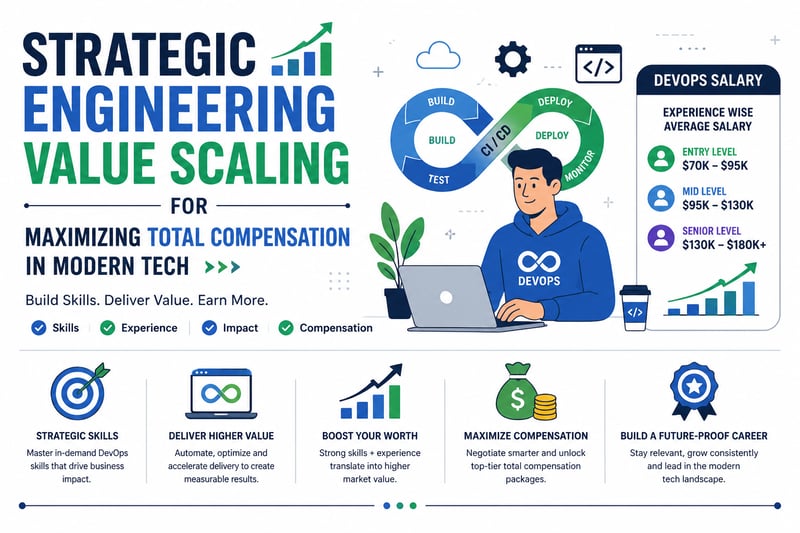
Technical professionals often find themselves trapped within stagnant pay brackets because they view their career growth through the lens of static job titles rather than market-driven impact. Compensation dynamics shift rapidly across the global technology ecosystem, yet most engineers lack the tactical data needed to secure premium agreements. This roadmap dissects the mechanisms behind high-value remuneration, teaching you how to quantify your infrastructure influence and negotiate from a position of absolute strength. Elevate your professional standing by mastering the core principles of the Best DevOps Salary framework today.
Defining The Economic Architecture Of Compensation
Corporate Intentions Behind Infrastructure Spending
Organizations allocate substantial resources toward infrastructure operations because stable, scalable systems act as the primary defense against revenue loss. Companies hire specialists not merely to maintain existing toolsets, but to eliminate deployment bottlenecks and safeguard production environments from costly downtime. Your financial package fundamentally measures how effectively your engineering interventions protect corporate profitability.
Operating The Compensation Matrix
Enterprise hiring models typically balance three levers to calculate your total earnings: guaranteed base cash, performance-linked variable bonuses, and long-term equity allocations. Recruitment teams utilize real-time market data to establish strict boundary conditions for every role. Consequently, your ability to secure the upper tiers of these boundaries depends entirely on your demonstrable mastery of system availability and complex architectural design.
Distinguishing Baseline Literacy From Premium Value
Standard hiring requirements simply confirm that you possess the fundamental knowledge to function within a technical team. Conversely, premium pay brackets remain reserved for those who transcend basic tasks by solving systemic business problems. Executives actively hunt for engineers who can architect cross-functional platforms, optimize massive cloud expenditures, and lead high-stakes digital transitions.
Critical Factors Controlling Your Earning Velocity
Leveraging Practical Tenure
Years spent in a role matter significantly less than the complexity of the systems you have successfully defended. Engineering leadership rewards specialists who possess the tactical foresight to resolve major outages and design self-healing production architectures. Proving your capability to steer massive, high-traffic environments earns you immediate professional respect and significantly higher starting offers.
Quantifying Expertise Through Continuous Advancement
Academic foundations initiate your journey, but relentless platform-specific mastery dictates your ultimate earning potential. The contemporary market heavily favors engineers who aggressively modernize their knowledge base regarding automated compliance, container security, and global microservice governance. This dedication to continuous upskilling signals high reliability to high-growth organizations.
Measuring Performance Via Business KPIs
Professional success depends on your ability to connect daily technical contributions to concrete business metrics. Organizations evaluate performance based on your impact on release frequency, service reliability, and recovery speeds during critical failures. You gain significant leverage in compensation reviews when you present transparent data demonstrating how your engineering work improved these vital operational indicators.
Navigating Global Financial Channels In Engineering
Segmenting Specialized Technical Disciplines
Modern hiring markets categorize technical roles into distinct functional tracks, each carrying its own specific market premium. While standard automation provides the necessary baseline, specialized domains—such as internal developer platform engineering, cloud financial management, and automated security orchestration—consistently attract significantly higher base pay. Talent shortages in these advanced niches effectively empower you to dictate your market price.
Comparing International Geographic Dynamics
Your physical location drastically changes the liquidity and structure of your compensation. Major tech hubs often bundle high base cash with substantial equity upside to incentivize rapid product development. In contrast, emerging technology markets offer explosive growth for remote specialists, allowing you to sidestep local pay caps by targeting global enterprises that value talent over regional boundaries.
Global Compensation Benchmarking Matrix
| Territory | Primary Financial Focus | Typical Variable Bonus | Standard Equity Prevalence |
|---|---|---|---|
| North America | High base salary and equity growth | 10% to 20% | Extremely High |
| Western Europe | Solid base with robust benefits | 5% to 15% | Moderate |
| Asia-Pacific | High-frequency performance cash | 15% to 30% | Expanding |
| Middle East | Tax-exempt base with relocation perks | 10% to 25% | Low |
Implementing A High-Leverage Negotiation Strategy
1. Cataloging Your Operational Successes
Maintain a precise record of your infrastructure wins, including specific cost reductions, uptime improvements, and automation successes. Collect testimonials from colleagues that highlight your technical leadership during production crises. Having this empirical evidence ready forces management to justify any initial offers that ignore your demonstrated value.
2. Sharpening Your Communication Strategy
Practice articulating your architectural choices and system design logic with complete confidence before your interview. Explaining the reasoning behind your technical decisions proves your seniority and distinguishes you from peers who only follow instructions. Articulate, data-backed dialogue ensures that leadership views you as a strategic partner.
3. Targeting Intense Talent Shortages
Analyze current job trends to find which specific cloud ecosystems face the most acute labor shortages. Tailor your resume to emphasize your expertise in these exact areas, presenting yourself as an immediate solution to a painful corporate problem. Matching your skill set to a clear market deficit ensures you command a premium starting offer.
4. Evaluating Total Economic Value
Factor remote flexibility, massive upskilling allowances, and comprehensive health benefits into your final compensation analysis. A slightly lower base salary often yields higher value than a rigid, higher-paying offer when you consider long-term learning budgets and life-balance perks. Always assess the entire employment agreement to ensure it satisfies your wealth and lifestyle goals.
5. Defining Your Financial Anchor
Calculate your target compensation—including base, bonus, and equity—before entering any contract discussion. Use this target as your unwavering anchor point to maintain composure and prevent yourself from settling for inadequate pay. Clarity regarding your expectations protects you from accepting an offer that fails to honor your market standing.
Strategies For Amplifying Your Value Multiplier
Aligning Technical Work With Business Revenue
Pivot your daily energy toward building systems that directly protect revenue and improve team productivity. Treat your infrastructure as a product designed to accelerate the work of every developer in the organization. Proving that your engineering work functions as a high-impact business multiplier makes your requests for peak compensation essentially unarguable.
Pursuing High-Scarcity Specializations
Differentiate your profile by mastering niche domains like policy-as-code, financial cloud optimization, and automated security governance. Experts in these sectors experience significantly less competition because organizations desperately need engineers capable of resolving complex, systemic issues. Mastering these areas inherently increases your value and safeguards your career trajectory.
Capitalizing On Performance Incentive Structures
Advocate for mathematical bonus structures that reward you for meeting specific availability milestones. Linking your pay directly to uptime objectives transforms your role from a standard corporate expense into a core financial defense system for the business. This alignment encourages leadership to view your compensation as a critical investment in corporate stability.
Frequently Asked Questions
- Does technical specialization significantly change my total earning potential? Mastering complex orchestration, automated governance, and deep observability networks allows you to demand a much higher rate than engineers with only general automation skills. Companies award peak compensation to specialists who resolve large-scale architectural issues.
- Can remote specialists secure top-tier rates while living in affordable regions? Indeed, elite firms prioritize access to world-class technical talent over your physical address. Building a strong architectural portfolio and documenting your systems work empowers you to bypass local salary suppression.
- What defines the typical balance between base cash and equity in senior positions? Established corporations emphasize high base salaries and cash bonuses, whereas high-growth platforms utilize equity to align your personal incentives with their expansion. Senior roles often feature a significant portion of total wealth tied to multi-year stock vesting.
- At what cadence should technical professionals audit their current salary benchmarks? Perform a deep market compensation review every twelve months to ensure your pay keeps pace with regional economic shifts and infrastructure demand. Consistent tracking identifies emerging trends early, giving you the lead time necessary to adjust your career path.
- Do certifications automatically guarantee entry into top-of-market brackets? Credentials validate foundational literacy, but proven real-world engineering dictates your actual pay. Businesses reward your ability to manage high-traffic systems and lead successful technical projects, not your paper records.
- How does managing high-severity incident responses improve my base compensation? Willingness to own critical system reliability serves as a massive negotiation lever. Enterprises reward the engineers who protect their revenue streams during major outages with superior base pay and rapid promotion tracks.
- How should an engineer handle initial salary inquiries during recruitment calls? Deflect early requests for specific numbers by prioritizing a discussion regarding the architectural scope and systemic challenges of the role first. Presenting a broad, data-backed market range rather than a single number preserves your leverage for final negotiations.
- Is transitioning from a traditional title to Platform Engineer financially advantageous? Absolutely, the market currently attaches a financial premium to platform engineers because they treat infrastructure as a scalable, internal product. This shift moves you from reactive ticket management to high-value systems architecture.
- Do regulatory compliance requirements alter local compensation ceilings? Regulated industries—such as banking and healthcare—often provide cash premiums to engineers who understand deep automated security compliance. Protecting a corporation from regulatory fines justifies elite-level compensation packages.
- Can you improve a fixed base salary by negotiating secondary benefits? Certainly, securing accelerated equity vesting schedules, significant vacation time, and generous educational stipends often yields more value than a slightly higher base salary. Evaluate the holistic economic value of your contract to ensure it satisfies your total requirements.
- What constitutes the most effective approach for using competing offers during internal reviews? Present alternative offers to your current leadership as neutral, objective evidence of your market value. This demonstrates your high demand while providing your manager a transparent opportunity to match your external benchmark.
- How does expertise in FinOps enhance your corporate leverage? Specializing in cloud financial management allows you to improve profit margins by eliminating infrastructure waste. Connecting your daily engineering decisions to measurable cost reductions makes you an indispensable asset that commands peak compensation.
Closing Observations On Professional Prosperity
Maintaining mastery over your compensation structure ensures your career growth keeps pace with your increasing technical sophistication. Financial success rewards those who look past arbitrary job titles to focus on solving high-value, revenue-protecting architectural challenges. By utilizing objective market data to guide your negotiations and your learning investments, you build a stable, prosperous career that honors your genuine technical contribution.



Top comments (0)