
Introduction
The management of enterprise infrastructure is undergoing a radical shift. Traditional monitoring methods, which rely heavily on static thresholds and manual alerts, are no longer sufficient for managing complex microservices and multi-cloud environments. The sheer volume of logs, metrics, and traces generated by these modern systems easily overwhelms manual operations teams, frequently resulting in alert fatigue and prolonged system downtime.
To address these challenges, Artificial Intelligence for IT Operations (AIOps) has emerged as a critical approach. By combining big data, machine learning, and automation, AIOps enables infrastructure to observe, analyze, and remediate issues autonomously. For IT professionals aiming to remain competitive in this changing landscape, shifting toward intelligent automation is a strategic career move. This guide provides a detailed roadmap for achieving the Certified AIOps Engineer credential, helping you transition from reactive firefighting to predictive infrastructure management.
What is Certified AIOps Engineer
The Certified AIOps Engineer is a professional credential designed specifically for technical practitioners who build, deploy, and maintain machine learning solutions within production IT environments. Moving far beyond abstract, high-level theory, this engineering-focused program validates the hands-on skills required to implement intelligent monitoring, automated anomaly detection, and self-healing systems.
Engineers pursuing this path demonstrate their practical competency in establishing real-time data ingestion pipelines, training statistical models on operational data, and integrating intelligent feedback loops directly into continuous integration and continuous deployment (CI/CD) pipelines. This certification serves as validation that a practitioner can transform theoretical machine learning concepts into functional, reliable, and highly automated IT operations.
Why it matters today's?
Modern software platforms generate vast streams of telemetry data that are too complex for human operators to analyze manually. When an incident occurs in a distributed system, finding the root cause through traditional dashboard analysis can take hours, directly leading to costly service outages.
AIOps matters today because it shifts the paradigm from reactive fixing to proactive prevention. By deploying machine learning algorithms directly onto live operational data, patterns and anomalies can be detected before they impact end-users. This level of automation reduces the mean time to resolution (MTTR), prevents operational burnout within engineering teams, and ensures that large-scale digital services remain highly available around the clock.
Why Certified AIOps Engineer certifications are important
Securing a professional certification in this domain establishes a standardized benchmark for expertise in automated operations. It proves to organizations that an engineer possesses both the theoretical background and the practical skills needed to modernize legacy monitoring stacks.
- Validates Specialized Skills: It proves your capability to handle advanced workflows like algorithmic event correlation and log clustering.
- Accelerates Professional Growth: Certified professionals regularly unlock senior engineering and architecture roles, separating themselves from traditional administration tracks.
- Minimizes Operational Risk: Certified engineers understand how to properly train, evaluate, and deploy operational models without introducing false alerts into production.
- Standardizes Team Workflows: For engineering managers, ensuring team members hold this certification helps establish unified practices for managing data pipelines and automated response systems.
why choose AIOps School ?
Selecting the right training and validation platform is essential when mastering a complex, data-driven domain. AIOps School has established itself as a dedicated platform for intelligent infrastructure education. The curriculum is built around practical, production-grade applications rather than simple academic concepts, ensuring students learn exactly what is required in real-world environments.
The platform provides comprehensive, end-to-end learning journeys that guide students from foundational concepts up to advanced enterprise architecture. Learners receive extended access to dedicated, live cloud laboratory environments, allowing them to safely configure pipelines, inject faults, and deploy live anomaly detection models. Combined with a vetted curriculum designed by active industry practitioners, a globally recognized credential system, and an engineering community for collaborative troubleshooting, the platform provides all the necessary resources to successfully transition into an automated operations role.
Certification Deep-Dive
What is this certification?
The Certified AIOps Engineer program is a technical, practitioner-level credential that validates an engineer's ability to build data pipelines, configure time-series anomaly detection, and deploy automated remediation systems in production environments.
Who should take this certification?
This certification is highly beneficial for DevOps engineers, Site Reliability Engineers (SREs), cloud engineers, platform architects, data engineers, and technical managers who are responsible for maintaining system uptime and automating large-scale IT operations.
Certification Overview Table
| Track | Level | Who it’s for | Prerequisites | Skills Covered | Recommended Order |
|---|---|---|---|---|---|
| AIOps Track | Foundation | IT Associates, Beginners | Basic IT concepts | Telemetry basics, Log analysis, AIOps core theory | First |
| AIOps Track | Engineer | DevOps, SREs, Systems Engineers | Linux, Basic Python, Monitoring | Data pipelines, Anomaly detection, Auto-remediation | Second |
| AIOps Track | Professional | Senior Engineers, Tech Leads | Engineer Level certification | Algorithmic correlation, Enterprise tools | Third |
| AIOps Track | Architect | Principal Engineers, Architects | Professional Level certification | Platform design, Governance, Multi-cloud scale | Fourth |
Skills you will gain
- Data Pipeline Engineering: Constructing robust streaming and batch data pipelines to collect, normalize, and route system logs, metrics, and traces.
- Anomaly Detection Implementation: Deploying statistical methods and machine learning models to identify real-time deviations in time-series telemetry.
- Automated Remediation: Designing event-driven runbooks and self-healing workflows that resolve common infrastructure issues without manual intervention.
- CI/CD Intelligence: Integrating automated quality gates and canary analysis into delivery pipelines to catch performance regressions early.
- Toolchain Integration: Evaluating, configuring, and connecting open-source and commercial observability platforms with intelligent alerting engines.
Real-world projects you should be able to do after this certification
- Self-Healing Disk Space System: Build an automated workflow that detects storage anomalies, triggers log rotation, and safely expands cloud volumes when thresholds are breached.
- Algorithmic Noise Reduction Pipeline: Create an event-driven filtering system that consolidates thousands of scattered infrastructure alerts into a single, correlated incident response ticket.
- Predictive Database Load Balancer: Implement a time-series forecasting model that predicts sudden web traffic spikes and auto-scales database read replicas before performance drops.
- Intelligent Canary Deployment Gate: Set up a delivery pipeline that automatically monitors log error rates during software rollouts and executes an instant rollback if anomalies are found.
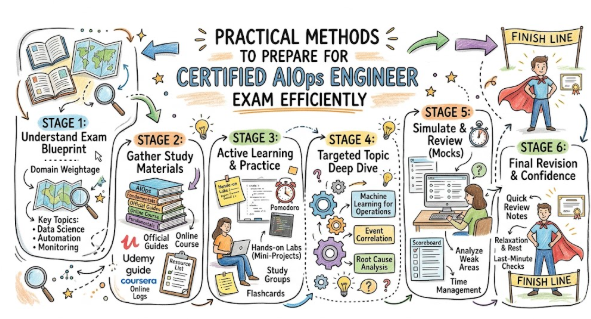
Preparation plan
7–14 days plan
- Focus on Core Concepts: Dedicate this initial period to mastering core terminology, understanding telemetry data types, and reviewing the blueprint modules.
- Study the Exam Objectives: Review the official documentation to identify any personal knowledge gaps in statistical baselines and time-series monitoring.
30 days plan
- Hands-on Lab Practice: Spend the middle weeks working directly within the live lab environments configuring data collection agents and ingesting metrics.
- Build Basic Detection Rules: Practice setting up dynamic thresholds and basic isolation forests using sample infrastructure datasets.
60 days plan
- Complete the Capstone Project: Spend the final weeks building a comprehensive, end-to-end pipeline that connects log collection, anomaly detection, and automated alert routing.
- Take Mock Examinations: Review scenario-based practice questions to build speed and confidence for the multi-choice and practical parts of the evaluation.
Common mistakes to avoid
- Skipping the Prerequisites: Attempting the practical labs without a solid understanding of basic Linux systems administration and foundational Python scripting.
- Focusing Only on Theory: Relying entirely on text guides while avoiding the hands-on lab environments where practical troubleshooting skills are tested.
- Ignoring Data Quality: Forgetting that anomaly detection models fail if the underlying log and metric data pipelines are poorly formatted or unnormalized.
- Overcomplicating the Automation: Designing overly complex remediation runbooks that lack proper safety confirmation gates, leading to accidental automated rollbacks.
Best next certification after this
- Same track: Certified AIOps Professional, which advances your technical skills into advanced event correlation, complex multi-variate analysis, and custom model tuning.
- Cross-track: Certified MLOps Engineer, shifting your focus toward managing the complete lifestyle, continuous integration, and continuous delivery of complex machine learning models.
- Leadership / management: Certified AIOps Architect, focusing on enterprise-wide governance, cost-benefit strategies, and designing large-scale intelligent operations frameworks.
Choose Your Learning Path
DevOps Path
This path is designed for engineers who want to infuse intelligence into the software delivery lifecycle. The focus is placed on building smart pipelines that leverage operational data to make automated choices. Practitioners learn how to set up intelligent quality gates that analyze application behavior during deployments, allowing the pipeline to automatically pause a release or trigger a rollback if any unusual system anomalies are detected.
DevSecOps Path
This track prioritizes system security by merging automated operations with real-time threat detection. Engineers on this path utilize machine learning models to continuously scan system logs and network traffic for behavioral anomalies that indicate a cyber-attack or policy breach. The main goal is to establish self-healing security systems that can identify and isolate compromised infrastructure components before threats spread across the network.
Site Reliability Engineering (SRE) Path
Reliability, high availability, and proactive incident management form the core of this path. SREs learn to apply machine learning models to system telemetry to manage error budgets and predict when infrastructure limits are being reached. Instead of waiting for a component to break, engineers learn to deploy automated, closed-loop remediation workflows that resolve underlying infrastructure issues well before service level objectives are impacted.
AIOps / MLOps Path
This specialized dual-focus track bridges the gap between infrastructure automation and machine learning lifecycle management. Engineers learn to maintain the underlying telemetry systems while simultaneously building continuous delivery pipelines for machine learning models. This path is ideal for professionals who want to master the infrastructure side of AI while ensuring models are reliably trained, versions are tracked, and code is safely deployed to production.
DataOps Path
Everything in automated operations relies on a continuous, clean flow of information. The DataOps path focuses heavily on the underlying operational data architecture. Engineers learn how to build, monitor, and scale robust data pipelines, ensuring that log data, traces, and metrics are cleaned, normalized, and delivered to machine learning engines without delay or data corruption.
FinOps Path
Cloud costs can easily spiral out of control in large, automated systems. This business-focused track teaches engineers how to apply machine learning algorithms to historical cloud billing and utilization data. Practitioners learn to build automated tracking engines that discover idle resources, predict monthly cloud expenditures, and implement intelligent auto-tagging policies to optimize enterprise infrastructure spending.
Role → Recommended Certifications Mapping in table
| Professional Role | Target Certification Recommended | Focus Area |
|---|---|---|
| DevOps Engineer | Certified AIOps Engineer | Automated pipelines and deployment monitoring |
| Site Reliability Engineer (SRE) | Certified AIOps Professional | Root-cause analysis and automated self-healing |
| Platform Engineer | Certified AIOps Architect | Designing enterprise-wide intelligent operations |
| Cloud Engineer | Certified AIOps Engineer | Ingesting multi-cloud telemetry and scaling data streams |
| Security Engineer | Certified DevSecOps Professional | Behavioral threat detection and automated security isolation |
| Data Engineer | Certified DataOps Engineer | Building stable data pipelines and maintaining data quality |
| FinOps Practitioner | Certified FinOps Specialist | AI-driven cost optimization and resource forecasting |
| Engineering Manager | Certified AIOps Architect | Operations governance, team upskilling, and value mapping |
Next Certifications to Take
One same-track certification to consider is the Certified AIOps Professional program, which expands your technical expertise by diving deep into advanced multi-variate anomaly detection, algorithmic event correlation, and complex production troubleshooting patterns.
One cross-track certification worth pursuing is the Certified MLOps Engineer credential, which focuses on the deployment, monitoring, version tracking, and automated continuous delivery of large-scale machine learning models within enterprise application stacks.
One leadership-focused certification to explore is the Certified AIOps Architect designation, which prepares senior professionals to lead digital transformations, establish enterprise data governance policies, and design scalable multi-cloud automation architectures.
Training & Certification Support Institutions
DevOpsSchool
This premier training provider is known for its highly practical, instructor-led technical bootcamps. A comprehensive library of on-demand video tutorials, 24/7 access to live cloud environments, and deep preparation courses are offered to assist professionals in passing their certifications on the first attempt.
Cotocus
Specializing in corporate upskilling and modern infrastructure consulting, this institution provides highly customized training programs for enterprise teams. Their courses are structured to map theoretical automation concepts directly to the specific production challenges faced by organizations.
ScmGalaxy
This established platform serves as a community hub and educational provider for configuration management and continuous delivery professionals. Deep dive technical blogs, community forums, and expert-led training tracks are regularly delivered to help engineers master complex infrastructure tools.
BestDevOps
Focused on delivering accessible, beginner-friendly learning paths, this training platform provides structured tutorials for core automation tools. Step-by-step documentation, guided practical labs, and foundational courses are emphasized to help traditional IT workers transition into modern cloud engineering roles.
devsecopsschool.com
This dedicated educational portal focuses exclusively on the intersection of system security and continuous delivery. Detailed training paths covering container compliance, automated security scanning, and shift-left testing methodologies are provided for modern security professionals.
sreschool.com
Built specifically for reliability professionals, this platform offers targeted training programs centered on site reliability practices. Deep instruction on managing error budgets, configuring advanced observability tools, and structuring incident response protocols is delivered.
aiopsschool.com
As the premier platform for intelligent operations training, this site offers the official curriculum and testing environments for the complete portfolio of certifications. Production-ready engineering guides, practical lab systems, and peer discussion forums are hosted here.
dataopsschool.com
This specialized educational institution provides training tracks focused entirely on data pipeline engineering and operational data management. Advanced techniques for data quality monitoring, automated data synchronization, and pipeline orchestration are covered.
finopsschool.com
Designed to bridge the gap between finance and cloud engineering, this platform provides focused education on cloud cost optimization. Structured courses covering billing analysis, algorithmic cost forecasting, and shared responsibility frameworks are provided.
FAQs Section
What is the overall difficulty level of these automated operations exams?
The certifications are structured sequentially, starting with an accessible foundation exam and moving up to highly technical practitioner and architect evaluations that require hands-on troubleshooting.
How much preparation time is normally required to pass the engineering exam?
Most working professionals dedicate between 30 and 60 days, spending a few hours each week reviewing documentation and completing practical lab assignments.
Are there any strict prerequisites required before attempting the engineer level test?
While there are no absolute administrative restrictions, a foundational understanding of Linux systems, basic Python scripting, and standard monitoring concepts is highly recommended.
What is the recommended certification sequence for a complete beginner?
An individual should start with the Foundation certification, progress through the Engineer and Professional credentials, and eventually target the enterprise Architect designation.
What career value does holding a certified credential bring to an IT professional?
Holding a certified credential provides verified proof of your ability to manage complex, data-driven systems, making you a highly competitive candidate for premium senior infrastructure roles.
Which job roles benefit the most from completing these training tracks?
DevOps engineers, Site Reliability Engineers, platform architects, cloud operators, and data engineers find these training tracks immediately applicable to their daily workflows.
How long does an official certification remain valid after passing the exam?
The credentials remain valid for a period of three years, after which professionals can renew by completing continuing education modules or passing a higher-level test.
Are the practical lab assignments included in the standard examination package?
Yes, official enrollment provides direct access to the required cloud lab environments, enabling candidates to build and test their projects safely.
How do these certifications help an engineer deal with production alert fatigue?
Engineers are trained to build algorithmic correlation systems that filter out minor system fluctuations, ensuring teams are only notified for critical infrastructure events.
Can traditional system administrators successfully transition through these courses?
Yes, the sequential learning structure is designed to help traditional administrators gradually layer data science and automation skills over their existing systems knowledge.
Do these programs focus on specific commercial tools or open-source frameworks?
The core curriculum is built around universal engineering principles and open-source standards, ensuring the skills can be applied across any commercial vendor stack.
What kind of post-certification support is available to successful candidates?
Graduates receive a digital credential badge for their professional profiles and gain entry into a private technical community for ongoing peer networking.
Certified AIOps Engineer
1. What specific percentage score is required to pass the Certified AIOps Engineer exam?
Candidates must achieve a minimum passing score of 72% on the combined multiple-choice and scenario-based engineering evaluation.
2. How long is the examination session for the practitioner certification?
The formal examination session is exactly 120 minutes long, giving candidates sufficient time to evaluate both conceptual and practical questions.
3. What is the total cost for the complete engineering examination package?
The standard package is priced at $499, which includes the necessary study guides, mock exams, lab access, and the formal testing attempt.
4. Is a live capstone project review required to secure the engineering credential?
Yes, candidates must build and submit an end-to-end automated pipeline project, which is fully reviewed by a platform instructor before the badge is issued.
5. Can the certification test be taken remotely from home or an office?
The examination is delivered online through a secure, supervised testing platform, allowing candidates to take the test from any appropriate location.
6. What specific machine learning concepts are covered in the engineering blueprint?
The blueprint focuses on time-series forecasting models, isolation forests for anomaly detection, clustering algorithms for log grouping, and multivariate correlation.
7. How many questions are presented during the engineering testing session?
The testing format contains a total of 75 multiple-choice questions along with several practical, scenario-based infrastructure troubleshooting assignments.
8. Does the exam package include access to practice tests?
Yes, full enrollment provides multiple realistic practice exams designed to closely mirror the style and difficulty of the official testing environment.
Testimonials
Rajesh
The structured labs allowed me to build an end-to-end data ingestion pipeline from scratch. My practical automation skills have improved significantly, and I now possess absolute confidence when managing complex telemetry data streams in production.
Amit
The training provided complete career clarity and showed me exactly how to transition from traditional monitoring to intelligent automation. I have been able to apply these exact anomaly detection techniques to resolve persistent alert fatigue within our engineering teams.
Priya
Our incident response speed has completely transformed since we implemented these automated remediation runbooks. The course material was deeply valuable, practical, and gave me the skills needed to confidently lead our platform modernization projects.
Vikram
I finally understand how to apply statistical and machine learning models to infrastructure logs. The practical projects provided real-world application skills that allowed me to set up an automated quality gate within our continuous delivery pipeline.
Sunita
This program gave me the technical depth and confidence needed to guide my team through a major infrastructure transition. The clear focus on data engineering and automation principles helped us establish a highly efficient, self-healing production platform.
Conclusion
Transitioning toward automated, data-driven operations is becoming an operational necessity for modern software organizations. The Certified AIOps Engineer credential provides a clear, highly structured path for professionals who want to master the skills needed to design, implement, and maintain intelligent production platforms. By validating your expertise in telemetry data pipelines, automated anomaly detection, and self-healing systems, this certification provides long-term career relevance and ensures you stand out in the global IT market. Taking a strategic approach to your continuous learning path today will ensure your technical skills remain invaluable as the industry moves toward fully autonomous infrastructure operations.




Top comments (0)