
Introduction
DevOps has cemented itself as one of the most rewarding career paths in the modern IT landscape. As businesses transition to cloud-native architectures, the reliance on automated delivery and resilient infrastructure has transformed DevOps from a niche operation into the backbone of digital innovation. This high demand, driven by the shift toward automation, containerization, and robust cloud ecosystems, ensures that professionals with the right skill set remain highly sought after across global markets.
DevOps Salaries in this field are increasingly tied to business impact. Whether it is ensuring high availability, optimizing cloud expenditure, or fortifying software supply chains, those who treat their infrastructure as a product rather than a service often see significant growth in compensation. Understanding these trends requires looking beyond basic tool knowledge; it requires recognizing how your contribution directly impacts organizational reliability, cost efficiency, and security.
This guide provides a practical overview of how DevOps salaries function, the factors that drive compensation, and how professionals—from freshers to seasoned architects—can strategically navigate their growth.
Why DevOps Salaries Are High
The primary driver behind premium DevOps salaries is the scarcity of professionals who can manage complexity at scale. Key factors include:
- Cloud Infrastructure Maturity: Companies are moving beyond basic "lift and shift" migrations to complex multi-cloud and hybrid environments, requiring deep architectural expertise.
- Automation and Toil Reduction: There is a heavy premium on engineers who can automate repeatable tasks, thereby reducing operational overhead and increasing team velocity.
- Kubernetes and Containerization: As the industry standard for orchestration, managing Kubernetes clusters at scale requires a high level of specialized skill that commands top-tier pay.
- DevSecOps Demand: Security is no longer an afterthought. Engineers who can embed security directly into the pipeline (policy-as-code, secrets management) are vital to modern enterprise operations.
- Operational Reliability: Businesses pay for uptime. SREs and engineers who can define and maintain Service Level Objectives (SLOs) and error budgets are essential for preventing costly outages.
Who Should Read This Guide
This guide is designed for individuals looking to understand the compensation landscape within the DevOps ecosystem, including:
- Freshers entering the technology sector.
- Developers transitioning into infrastructure and automation roles.
- Linux Administrators and System Engineers expanding into cloud operations.
- Specialized roles such as SREs, Platform Engineers, and DevSecOps professionals.
DevOps Salary Overview
DevOps compensation is currently fragmenting into distinct market segments:
- Big Tech/High-Scale Product Orgs: Often equity-heavy, these roles prioritize high-level engineering skills and deep system design.
- Enterprise/Regulated Orgs: Focus on bonus structures and high base pay for stability and governance.
- Services/Outsourcing: Compensation is frequently tied to rate-card models, prioritizing efficient execution and project delivery.
Compensation generally scales with the ability to own a "paved road" or internal platform. Moving from being a "pipeline implementer" to a "platform owner" is a key shift that often triggers a jump in salary bands.
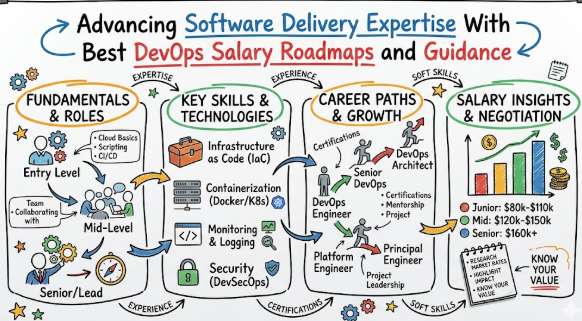
DevOps Salary by Experience Level
| Experience Level | Typical Roles | Skills Expected | Salary Growth Potential | Career Scope |
|---|---|---|---|---|
| Fresher | Junior DevOps Engineer | Linux basics, Scripting, Git | Foundational | Learn on-call basics |
| Mid-Level | DevOps Engineer | CI/CD, Terraform, Docker | Significant | Independently ship changes |
| Senior | Senior DevOps Engineer | Kubernetes, Cloud Architecture | High | Design systems, Lead incidents |
| Lead / Architect | Platform / SRE Architect | Reliability strategy, Platform product | Very High | Cross-team architecture |
Highest Paying DevOps Roles
Roles focusing on reliability, security, and internal platforms currently carry the highest premiums.
| Role | Main Skills | Difficulty Level | Salary Potential |
|---|---|---|---|
| DevOps Engineer | CI/CD, Infra Automation | Moderate | Baseline |
| SRE Engineer | SLOs, Incident Response | High | High |
| Platform Engineer | Internal Platforms, Paved Roads | High | High |
| DevSecOps Engineer | Policy-as-code, Secure SDLC | High | Very High |
| FinOps / Cost Engineer | Unit cost, Governance | Moderate | Moderate/High |
DevOps Salary by Skills
Salary potential is directly influenced by technical depth in specific, high-demand areas:
- Core Foundations: Linux, Networking, and Shell scripting are baseline requirements.
- Infrastructure & Automation: Proficiency in Terraform, Ansible, and Cloud-native tools is essential for mid-level growth.
- Orchestration & Observability: Kubernetes, Prometheus, and Grafana are standard for senior positions.
- Security & Governance: Skills in DevSecOps (policy-as-code) and FinOps (cost engineering) represent the highest current premiums.
Factors That Affect DevOps Salary
Beyond years of experience, your market value is determined by:
- Decision Authority: Great companies pay for your ability to design systems and make technical decisions.
- Reliability Ownership: If your work is tied to revenue uptime or regulatory exposure, your compensation ceiling changes.
- Scarcity: Specialized skills like security platform development or multi-region reliability are currently scarce and highly valued.
- Operational Maturity: Working in an environment that values toil reduction and incident process maturity leads to faster professional growth.
Common Mistakes That Reduce Salary Growth
- Focusing on Tools over Outcomes: Learning a tool without understanding how it solves a business problem limits your impact.
- Neglecting Foundations: Skipping Linux or networking basics creates gaps in your troubleshooting ability.
- Ignoring Cost: Failing to understand cloud economics (FinOps) means you miss out on a key area of executive visibility.
- Weak Communication: The ability to explain technical debt or infrastructure strategy to stakeholders is as important as writing code.
Hands-On Projects to Increase Salary Opportunities
To stand out, build projects that demonstrate end-to-end thinking:
- CI/CD Pipeline Design: Create a secure, automated pipeline that includes testing and vulnerability scanning.
- Platform as a Product: Develop a "paved road" tool that simplifies infrastructure deployment for other developers.
- Reliability Engineering: Implement SLOs and monitoring for an application, including a formal incident response plan.
- Security Integration: Build a pipeline that enforces security policies as code before deployment.
FAQs
Is DevOps a high-paying career?
Yes, DevOps remains a high-paying career due to the ongoing shift to cloud-native operations and the continuous demand for reliable, automated infrastructure.
Which DevOps skill gives the highest salary?
Skills related to security platform engineering (DevSecOps), reliability engineering (SRE), and cost engineering (FinOps) currently command significant salary premiums.
Does certification increase salary?
Certifications can validate expertise, but true salary growth comes from applying those skills to real-world business risks, such as improving revenue uptime or reducing cloud bills.
Is Kubernetes good for salary growth?
Yes, Kubernetes is the industry standard for orchestration; mastering it at scale is vital for senior-level roles.
How long does it take to become a DevOps engineer?
The timeline varies, but shifting from a "pipeline implementer" to a "platform owner" is a journey that involves mastering system design, reliability principles, and automation over several years of hands-on experience.
Final Recommendation
To thrive in the DevOps space, prioritize operational outcomes over simple tool collection. Focus on learning how to tie your technical work to business value—whether that means improving system reliability, optimizing costs, or enabling your team through better platform design. Continuous learning is essential, but it should always be grounded in practical projects that solve real-world problems. By focusing on reliability, security, and internal platform thinking, you will position yourself for long-term career growth and top-tier compensation.



Top comments (0)