
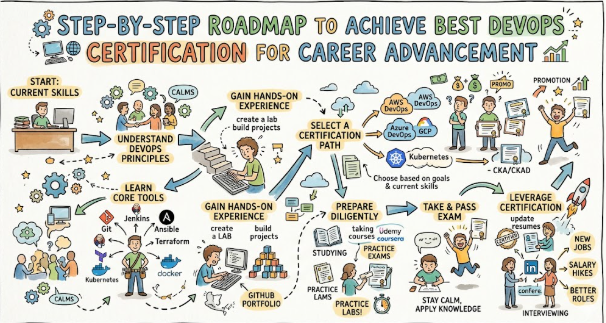
Introduction
The modern tech landscape is moving faster than ever. As organizations push to integrate artificial intelligence (AI), machine learning (ML), data engineering, and highly secure software supply chains into their workflows, the demand for multidisciplinary engineers has skyrocketed. Navigating this vast landscape can be overwhelming. Professionals frequently struggle to figure out which credentials carry real industry weight, how to structure their learning roadmaps, and how to avoid the trap of collecting certificates without gaining true operational engineering skills. Finding the Best DevOps Certification tailored to your career goal is the most effective way to cut through the noise, build structure around your learning, and prove your capabilities to hiring managers.
Choosing the right credential helps you stand out in an increasingly crowded job market. Whether you are aiming to master cloud infrastructure, container orchestration, automated security (DevSecOps), Site Reliability Engineering (SRE), or modern GitOps and MLOps pipelines, a strategic certification path serves as your technical compass. This comprehensive guide breaks down the top credentials in the industry, maps them to realistic career paths, and outlines the precise skills required to dominate the modern automation market.
What is a DevOps Certification?
A Best DevOps certification is an independent, industry-recognized validation of an engineer’s ability to implement culture, automation, lean processes, and collaborative tools across software development and IT operations. Unlike broad academic degrees, these credentials focus heavily on specific, practical domains. They validate your skills in configuring infrastructure as code (IaC), managing automated pipelines, handling large-scale container deployments, and building automated security safeguards directly into code deployment streams.
The true value of preparing for the best DevOps certification lies in its structured learning framework. Instead of learning tools in isolation, candidates are forced to solve real-world architectural problems. Modern certifications have evolved away from simple multiple-choice formats toward hands-on, performance-based laboratory testing. This ensures that when an individual passes an exam, they have demonstrated concrete, verifiable troubleshooting and systems configuration skills under real-world constraints.
Why DevOps Certifications Matter
In today's competitive tech job market, certifications act as a filter for hiring managers who receive hundreds of resumes for a single open position. They provide instant credibility, showing that an external authority has vetted your technical baseline. Beyond merely boosting your resume, the process of preparing for an intensive credential closes crucial knowledge gaps that you might miss while working solely within a single company's specific, localized tech stack.
Step-by-Step Impact of Getting Certified
- Structures Advanced Learning Paths: Forces you out of your comfort zone by covering advanced architectural patterns and edge-case troubleshooting scenarios you might not encounter in daily tasks.
- Standardizes Team Technical Language: Helps teams adopt uniform industry terminology, tools, and structural patterns, reducing onboarding friction and architectural misunderstandings.
- Passes Automated HR Filters: Places your resume at the top of automated recruitment pipelines by matching critical keywords required for complex enterprise roles.
- Unlocks Higher Compensation: Validates specialized skills like Kubernetes management, security compliance, or MLOps engineering, which command premium salaries globally.
- Boosts Partner Status for Employers: Helps technology consulting firms and managed service providers meet mandatory certified staff counts to maintain elite partner tiers with major cloud providers.
Who Should Take DevOps Certifications?
DevOps certifications are not exclusively designed for dedicated DevOps engineers. The modern shift toward platform engineering and multi-cloud systems means that professionals across the entire software development life cycle can benefit from learning automated infrastructure and reliable delivery patterns.
- Students and Freshers: Individuals looking to break into tech by validating their foundational knowledge of Linux, cloud ecosystems, scripting, and basic automation pipelines.
- Software Engineers: Developers who want to master deployment lifecycles, understand where their code runs, and build highly resilient, cloud-native software architectures.
- System Administrators and Cloud Engineers: Professionals migrating from legacy on-premises infrastructure to automated, software-defined cloud platforms using GitOps.
- SRE and Platform Engineers: Specialists focused on building internal platforms, improving system availability, reducing operational toil, and perfecting modern observability dashboards.
- DevSecOps and Security Engineers: Security professionals aiming to shift security left by automating compliance, vulnerability scanning, and secrets management directly within CI/CD pipelines.
- Data and Machine Learning Engineers: Tech professionals seeking to apply robust continuous delivery principles to data flows and model training pipelines (MLOps).
Core Skills Covered
Reviewing the best DevOps certification programs reveals a common set of core technical competencies that form the foundation of modern infrastructure engineering.
- Continuous Integration and Continuous Delivery (CI/CD): Designing automated pipelines that test, build, and deploy code changes safely, frequently, and predictably.
- Infrastructure as Code (IaC): Treating physical and cloud infrastructure exactly like application software by writing declarations using tools like Terraform or OpenTofu.
- Containerization and Orchestration: Packaging applications with all their dependencies using Docker, and managing them across distributed compute clusters using Kubernetes.
- Cloud Infrastructure Architecture: Configuring secure, highly available networks, compute instances, storage buckets, and managed services within platforms like AWS, Azure, or Google Cloud.
- Observability and Monitoring: Collecting logs, metrics, and traces with tools like Prometheus, Grafana, and ELK stacks to troubleshoot system degradation before it impacts end users.
- DevSecOps Integration: Automating static and dynamic application security testing, managing secrets safely, and validating compliance configurations programmatically.
Table 1 – Best DevOps Certifications
The table below outlines twenty industry-leading certifications, their target skill levels, primary focuses, and career paths.
| Certification Name | Best For | Skill Level | Career Direction |
|---|---|---|---|
| AWS Certified DevOps Engineer – Professional | Advanced AWS automation and governance | Professional | Cloud DevOps Engineer |
| Microsoft Certified: DevOps Engineer Expert | Azure enterprise environments and tooling | Expert | Azure Platform Specialist |
| Google Cloud Certified - Professional Cloud DevOps Engineer | Google Cloud architectures and SRE mechanics | Professional | SRE / GCP Cloud Engineer |
| Certified Kubernetes Administrator (CKA) | Core cluster administration and operations | Intermediate | Kubernetes / Platform Engineer |
| Certified Kubernetes Application Developer (CKAD) | Designing and packaging cloud-native apps | Intermediate | Cloud-Native Developer |
| Certified Kubernetes Security Specialist (CKS) | Hardening cluster security and container runtimes | Advanced | DevSecOps Specialist |
| HashiCorp Certified: Terraform Associate | Multi-cloud Infrastructure as Code automation | Foundational | Infrastructure Engineer |
| Docker Certified Associate (DCA) | Core containerization runtimes and networking | Foundational | Container Engineer |
| Red Hat Certified Specialist in Ansible Automation | Configuration management and OS orchestration | Intermediate | Systems Automation Engineer |
| Certified DevSecOps Professional (CDP) | Practical pipeline vulnerability integration | Intermediate | DevSecOps Engineer |
| GitOps Certified Associate | Declarative continuous delivery via Git | Foundational | GitOps Practitioner |
| Linux Foundation Certified System Administrator (LFCS) | Core Linux operating system engineering | Foundational | Systems Administrator |
| Prometheus Certified Associate (PCA) | Cloud-native time-series systems monitoring | Foundational | Observability Specialist |
| Grafana Certified Associate | Building operational metrics dashboards | Foundational | SRE / Monitoring Analyst |
| GitHub Actions certifications | Automating software delivery on GitHub | Foundational | CI/CD Pipeline Engineer |
| GitLab Certified DevOps Professional | Single-platform enterprise lifecycle management | Intermediate | DevOps Platform Engineer |
| Datadog Certified Cloud Automation Engineer | SaaS-based enterprise cloud observability | Intermediate | Site Reliability Engineer |
| AWS Certified Machine Learning – Specialty | Productionizing ML models on AWS infra | Advanced | MLOps Engineer |
| Google Cloud Professional Machine Learning Engineer | Scalable MLOps and AI data pipelines | Professional | MLOps Architect |
| HashiCorp Certified: Vault Associate | Centralized cloud secrets management | Foundational | Cloud Security Architect |
Certification Deep Dive
To understand how these programs translate into professional settings, it is helpful to look at an overarching architectural profile of an advanced DevOps certification ecosystem. This unified deep dive highlights the practical components that make top-tier certifications valuable to engineering teams.
Real-World Use Case
Imagine an enterprise e-commerce platform facing sudden traffic spikes during a global holiday sale. An uncertified team might struggle with manual server configuration, slow deployment speeds, or late-stage security vulnerabilities. An engineer trained under a rigorous certification framework designs a multi-region, self-healing system. They use infrastructure as code to provision resources dynamically, containerized clusters to handle scaling instantly, automated pipelines to push quick hotfixes without downtime, and live monitoring dashboards to catch errors before they reach customers.
Skills You Will Learn
- Immutable Infrastructure Deployment: Writing clean, modular declarations to provision and modify multi-cloud architecture safely without manual server drift.
- Production Cluster Troubleshooting: Diagnosing broken container networks, fixing misconfigured access permissions, and repairing failed nodes under real-world time pressure.
- Left-Shift Security Implementation: Injecting automated code scanning, dependency tracking, and secret masking directly into development code branches.
- Data-Driven SRE Metrics: Designing tracking systems for Service Level Indicators (SLIs) and Service Level Objectives (SLOs) to quantify application health accurately.
Career Scope
The market for cloud automation professionals continues to expand across banking, healthcare, retail, and tech startups. Completing these tracks qualifies you for high-impact roles such as Infrastructure Engineer, Site Reliability Engineer, DevSecOps Director, or Platform Architect. These positions sit at the heart of enterprise digital transformations and carry significant leadership potential.
Difficulty Level
Varies from Foundational (for entry-level knowledge exams requiring 1 to 2 months of study) to Advanced/Expert (for intensive, 2 to 3-hour live terminal labs requiring 6 to 12 months of deep hands-on experience and real-world system engineering practice).
Best Career Fit / Who Should Take It
Ideal for working technology professionals who feel stuck handling manual, repetitive deployments and want to transition into writing software that manages infrastructure. It is a perfect fit for analytical thinkers who enjoy automation, architecture design, and creating resilient, self-healing systems.
Hands-On Projects
- The Multi-Cloud GitOps Pipeline: Deploy an application across cloud environments using declarative manifests, triggered completely by code commits, with zero manual server changes.
- The Zero-Trust Kubernetes Cluster: Build a multi-node cluster, restrict container privileges using network policies, integrate encrypted secrets storage, and verify security compliance via automated scanners.
DevOps Certification Roadmap
Embarking on an automation career requires a clear, logical progression. Trying to master advanced MLOps or Kubernetes security before understanding basic Linux commands or cloud networking is a recipe for frustration.
Table 2 – Career Certification Roadmap
| Career Goal | Recommended Certification Path | Why It Fits |
|---|---|---|
| Entry Level Cloud/SysAdmin | LFCS → Terraform Associate → AWS Associate | Establishes fundamental OS competency, basic IaC syntax, and core public cloud mechanics. |
| Cloud DevOps Engineer | AWS/Azure Professional → CKA → GitHub Actions | Validates your ability to build production-grade pipelines and manage enterprise container clusters. |
| DevSecOps Specialist | CKA → CKS → Certified DevSecOps Professional | Combines core container management skills with advanced runtime security and compliance scanning. |
| Site Reliability Engineer | CKA → Prometheus Certified → GCP Cloud DevOps | Pairs deep container orchestration skills with open-source observability frameworks and classic SRE theory. |
| MLOps / AI Engineer | AWS/GCP ML Specialty → CKAD → Terraform Associate | Bridges the gap between data science model training and production-grade, automated cloud environments. |
Types of DevOps Certifications
Understanding how certifications are categorized helps you select the exact match for your daily engineering tasks and career aspirations.
1. Cloud-Specific DevOps Certifications
These tracks focus entirely on the deep ecosystems of individual public cloud vendors. They teach you how to optimize vendor-specific tooling—such as AWS CodePipeline, Azure DevOps, or GCP Cloud Build. These certifications are incredibly valuable if your company is committed to a single cloud vendor and needs to utilize its native services efficiently.
2. Tool-Agnostic and Open-Source Certifications
These credentials validate your expertise in industry-standard open-source technologies that work across any operating system or cloud environment. Examples include the Linux Foundation's CKA/CKS or HashiCorp’s Terraform tracks. They prove you understand core computing principles, making your skills highly adaptable and preventing vendor lock-in.
3. Role-Based Specialty Certifications
As the market has matured, specialized disciplines have emerged within the broader DevOps umbrella:
[Foundational Systems/Cloud] ──► [Core DevOps & Containers] ──► [Specialized Paths: DevSecOps / SRE / MLOps]
- DevSecOps Path: Focuses heavily on automated security compliance, container runtime defense, and securing software supply chains.
- SRE and Observability Path: Centers on handling production systems at scale, tracking performance metrics, managing alerts, and optimizing site uptime.
- MLOps Path: Tailored specifically for data engineering pipelines, managing GPU workloads, and automating machine learning model deployments.
Common Mistakes to Avoid
- Collecting Certificates Without Hands-On Practice: Passing multiple-choice exams using brain dumps without knowing how to debug a live broken system in a real terminal.
- Skipping Core Infrastructure Fundamentals: Attempting to master complex service meshes or Kubernetes orchestration before understanding basic Linux networking, file permissions, and DNS routing.
- Focusing Exclusively on a Single Tool: Becoming a specialist in one proprietary tool while failing to learn the underlying patterns that apply across alternative technologies.
- Ignoring Code Quality and Version Control: Writing messy, unversioned scripts instead of treating infrastructure configurations exactly like production application code.
- Neglecting Soft Skills and Team Culture: Forgetting that true DevOps requires breaking down silos, communicating clearly, and collaborating effectively across teams.
Real-Life Examples
To see how these concepts function in production environments, consider these real-world scenarios:
- Example 1 (FinTech Security): A banking platform integrated the Certified Kubernetes Security Specialist (CKS) framework to automate runtime vulnerability scanning, instantly catching a critical dependency flaw before it hit production.
- Example 2 (SaaS Scaling): An enterprise software provider used Certified Kubernetes Administrator (CKA) methodology to redesign their scaling policies, allowing them to handle a 400% traffic spike during a major live event without any user degradation.
- Example 3 (Multi-Cloud Efficiency): A retail company applied HashiCorp Terraform Associate patterns to migrate their infrastructure, cutting environment setup times from three weeks of manual configuration to just fifteen minutes of automated execution.
- Example 4 (Automated AI Deployments): An autonomous driving startup used MLOps engineering principles to automate their data ingestion and model testing pipelines, reducing the time required to deploy new vehicle safety updates from months to days.
- Example 5 (E-Commerce Observability): A major online streaming service used Prometheus and Grafana certification methodologies to build custom dashboards, reducing their Mean Time to Resolution (MTTR) for system errors from hours to under two minutes.
FAQs
1. Which is the best DevOps certification for absolute beginners?
The HashiCorp Certified: Terraform Associate or a foundational cloud certificate like the AWS Certified Cloud Practitioner paired with the Linux Foundation Certified System Administrator (LFCS) is ideal. These exams establish a solid baseline in basic operating system tasks, cloud terminology, and infrastructure declarations without overwhelming you with advanced orchestration logic right away.
2. Are performance-based certifications better than multiple-choice ones?
Yes, certifications like the CKA, CKAD, CKS, and LFCS require you to solve real problems in live terminal environments. This format carries immense weight with technical interviewers because it proves you can configure, debug, and maintain actual production environments under time constraints, rather than just memorizing answers.
3. How long does it take to prepare for an advanced DevOps certification?
For an intermediate to advanced track like the AWS DevOps Professional or the CKA, it typically takes 3 to 6 months of consistent study if you already have some IT experience. Beginners should expect to spend 6 to 12 months building their foundational knowledge of scripting, networking, and cloud services before attempting these exams.
4. Do DevOps certifications expire?
Most major certifications from vendors like AWS, Microsoft, Google, and the Linux Foundation are valid for 2 to 3 years. Because cloud technologies evolve rapidly, you must periodically recertify by taking an updated version of the exam or passing a higher-tier credential to keep your certifications active.
5. Can I get a DevOps job by only holding certifications?
Certifications help you pass initial resume screens and land interviews, but they must be backed by a portfolio of practical work. You should combine your certifications with personal lab projects, documented GitHub repositories, and a deep understanding of core systems engineering to clear technical interviews.
6. Is coding required for a career in DevOps?
Yes, a foundational understanding of coding is necessary. You do not need to be an expert software developer, but you must be comfortable writing and reading scripts in languages like Python or Bash, and interpreting configuration formats like YAML and JSON to build automation pipelines.
7. What is the difference between DevOps and SRE certifications?
DevOps certifications generally focus on the entire software delivery lifecycle, emphasizing CI/CD pipelines, automation, and team collaboration. SRE certifications focus heavily on the production phase, teaching you how to keep large-scale systems highly available, scalable, resilient, and observable.
8. Should I learn AWS, Azure, or Google Cloud first?
AWS currently holds the largest market share globally, making it a highly versatile choice for most engineers. However, if your target employers or geographic region rely heavily on Microsoft enterprise software, Azure is an excellent path. Google Cloud is highly favored by teams focused on deep analytics and advanced Kubernetes architectures.
9. Why is GitOps becoming an essential certification domain?
GitOps uses Git repositories as the single source of truth for your infrastructure definitions. Earning a GitOps credential proves that you know how to implement automated continuous delivery patterns where any changes made to Git are automatically synchronized with your live infrastructure, making deployments audit-ready and highly secure.
10. Is an MLOps certification worth it for data scientists?
Absolutely. Traditional data science focus areas often stop once a model is trained. An MLOps certification teaches data professionals how to package those models into containers, build automated training workflows, monitor for data drift, and maintain models at scale within reliable production environments.
Conclusion
Earning the best DevOps certification for your specific career stage is a proven way to master modern IT infrastructure. True success in this field requires a balanced approach. While certifications provide a structured learning path and help you clear initial recruitment filters, they must be supported by continuous hands-on laboratory practice and real-world project portfolios.
By mapping your professional goals to a logical roadmap—starting with operating system fundamentals, progressing through container deployment, and specializing in DevSecOps, SRE, or MLOps—you build a resilient career. Focus on understanding the core design patterns behind the tools, configure systems from scratch, and use these credentials to validate your transformation into a well-rounded engineer.



Top comments (0)